

By Mario Flecha
One of our closests collaborators has been associated with the British and European art scence for decades. He is, nowadays, primarily a story teller but he is also an art critic and ex-editor of the art magazine Untitled. Here he dissects the work of a multidisciplinary London based young Colombian artist, Isabela Cordoba, whose paintings seeks to marry two different languages: the idiom of physiological processes and the syntax of artistic expression
It is a well established fact that many artist of recent times have produced some of their most impressive œuvre in exile. The exception I can think of are filmmakers but writers and painters have often departed from their own shores to live and work overseas. Such is the case of Colombian multifacted creator Isabela Cordoba. Her nomadic existence has taken her to Buenos Aires, Madrid and now London. But what is interesting in her case is that her peripathetic life has also extended itself to the art forms she has cultivated and practised: singing, acting and watercolouring. In fact she decided to write her own manifesto to explain his multidisciplinary approach to art: “Multiplicity is my language. Contradiction is my method. Excess is my truth. I paint as I act. I act as I sing. I sing as I breathe. Each gesture contaminates the next, each discipline infects the other.” And “infects” is a curious word when we talk about artistic endevours that are supposed to complement each other. However, when we closely look at her work as a watercolourist, we might understand that choice of verb.
Her manifesto, purportedly, provides the conceptual key to understanding the work. However, and in a more mundane way, I believe it helps her to defend herself against accusations of a multifaceted output -which among many British critics and artists is nothing less than a cardinal sin- while trying to validate what she tries to achieve in her watercolours: “I approached each painting the way I approach a character: preparing emotionally, stepping into a scene, inhabiting a feeling until it pulsed through my skin.”
Sensory Activation is her most recent work. In it Isabela’s paintings seem not to be concerned with depicting objects in the external world. What she sets out to do is a quite more ambitious: to make perceptible something less tangible, an inner sensation, a psychological disturbance, a moment of desire, a memory or a bodily response. Consider the titles of some of her watercolours: Melancholia, Desire, Passion, Anxiety and Equilibrium. These are not descriptions of things we can see. They name states of being, paintings that invite us to consider how such states might be experienced visually without being reduced to an illustration or a literal representation.
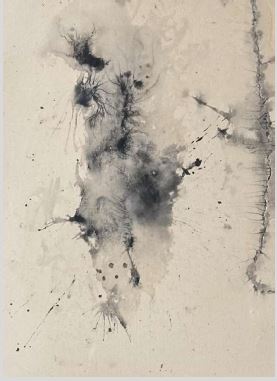
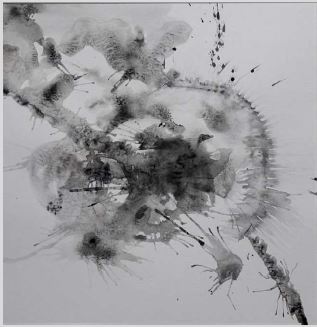
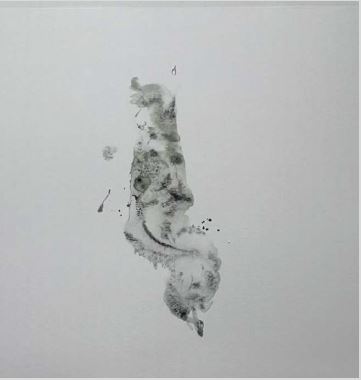
Melancholy, Passion and Equlibrium
One could suggest that her work invokes the possibility of painting the invisible, that artistic purpose and ambitioun I have already referred to. Her canvas intent to make perceptible something less tangible. It is not coincidence therefore that one of her pieces is called Synesthesia; a perceptual phenomenon which could well encapsulate the entirety of her painting work in one word. But synesthesia in the art world has been, as far as I know, confined almost exclusively to conceptual artists manipulating smells and sounds; mediums in which the synesthetic experience can be lived more directly. Thus, not surprisingly two of her pieces of her collection are entitled Pungency and Olfatory Satisfaction. However in Cordoba’s work and words synesthesia probably means somehting slightly different: looking at the two dimensional and fluid world of the watercolours differently. The achievement to explore here is the possibility that abstraction can communicate something recognisable without having to prescribe exactly what the viewer must see or feel.
Central to this series there is also, if not a neurological preoccupation at least a recognition of the sensorial activation that her work invites us to experience. Pigment disperses, blooms, accumulates and fades. Edges can be sharply defined in one place and dissolve almost imperceptibly in another. Stains, splashes, fine trails and translucent layers produce forms that appear to be emerging, changing or disappearing before our eyes. And we see it in paintings such Synaptogenesis, Synaptic Plasticity, Proprioception and Hyperesthesia. This lexicum is a deliberate attempt to educate the observer about the newest understandings not only of forms of perception but the very much in vogue vocabulary associated with neurodiversity. Whatever the case or, perhaps we should say, the title of the piece; in works such as X-ray of Last Drop, Visceral Sensation, Tinnitus or the already mentioned Proprioception, the contrast between dark marks and pale washes gives those paintings a sense of physical immediacy. There are blues, greens and more luminous brushes in Synaptic Plasticity or Hyperesthesia maybe as a way of suggesting heightened perception, excitation or even sensory disturbance. In this respect, I wonder if the number and prominence of watercolours in black and white are a deliberate ironic statement -i.e. monocromatic watercolours- or if that choice serves any other purpose.
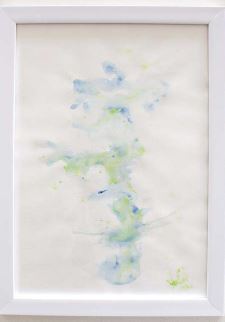
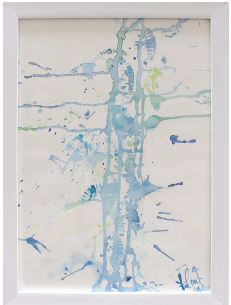
Hyperesthesia and Synaptic Plasticity
I ought to highlight an important point: for Isabela Cordoba watercolour is not simply a convenient vehicle for an idea she has already conceived. The result is in itself the need to visualise express the process. She has decided to work with a medium whose fluidity, transparency and unpredictability can mirror the instability of emotion. That might serve as an explanation of why her portfolio repeatedly moves between emotional vocabulary and the language of the nervous system. The names of some of the pieces we have enumerated elicet the processes through which we perceive, interpret and respond to the world. Her artisitc project’s central proposition is that the body registers a sensation before the conscious mind has fully interpreted it. Watercolour, with its rapid transitions and the interplay of pigment, water and paper, becomes a means of exploring the reality of this process.
A small paradox emerges when we consider the sometimes scientific, almost clinical titles of her work while the images remain fluid, elusive and emotional. So, rather than illustrating scientific concepts literally, Ms Cordoba’s works invite us to consider the sensory and emotional experiences those concepts help us name. No doubt she will be the first to agree that her work has sought to wed two different languages: the idiom of physiological processes and the syntax of artistic expression. “…each discipline infects the other.”
Emotions rarely exist in isolation. Desire may contain apprehension; passion may approach chaos; melancholy may coexist with attachment. Even equilibrium can be understood not as the absence of disturbance but as a temporary balance among competing forces. These paintings can therefore be read not as a catalogue of separate emotions, but as an exploration of the plurality and instability of lived experience.
Observing her work with a clinical eye, while at the same time attempting to keep an open mind, one could argue her effort to marry emotions and sensations is, on many levels, a rare and unqiue achievement.
Mario Flecha es escritor, crítico de arte, antologista, ex-editor de la revista de arte Untitled y uno de los colaboradores mas asiduos de Perro Negro. Es autor, entre otros, de los títulos Profesor Monday Zofana y El Trapecista. Actualmente divide su tiempo entre España e Inglaterra. Agnes La ibicenca hace parte de su último libro de relatos Tiquismiquis (2025) publicado por Ediciones de Jafra Project

Other Articles
La risa de la antigüedad I

No Comment! Be the first one.