

By Pauline De Souza
Although it should be much more common for filmmakers to venture into the world of the visual arts, we get that crossover more often from musicians and even politicians than from movie directors. Continuing our collaboration with Untitled Magazine, a brief archive note on une exposition de fin de siècle of one of the most audacious and interesting British directors of all time
On hearing the Cornerhouse were showing a wide selection of Peter Greenaway’s paintings, works on paper and photographs, people could be forgiven for assuming that they would be similar to his controversial films. In fact, the works bear no signs of Greenaway’s arrogant character, which journalists, some feminist critics and film critics find so problematic. This does not mean the works are mediocre or insignificant for Greenaway still relishes the antagonism made manifest in the work’s themes and his catalytic creativity. It would be difficult not to admire the Stellarscapes (1968) whose imagery is concerned with cybernetics and outer space. These works take as their source the Institute of Contemporary Art’s 1968 exhibition Cybernetic Serendipity, a compelling exhibition that covered experiments in art, music and poetry. The general idea of this exhibition was to explore the relationship between scientific systems of control and human communication. But what of Greenaway’s Stellarscapes? Compared with some of the humbling science-art projects in the 1968 exhibition and with some of the recent electronic art exhibitions they do not celebrate rationality and technological process but are a reaction to oppressive theories of control, offering alternative methods of mapping based on illogical or chance elements. Stellarscape: Vertical uses a tonal system to organise the stars.
Stellarsape: Semicircle is fitted with a numerical system to count the infinite number of stars while Stellarscape: Grid uses a grid structure to map the mist of stars that are very close to the surface. In some recent electronic art exhibitions, this reaction against art and technology is apparent. It also seems even after thirty years and despite the fact electronic art can be seen in most public galleries, technology or to be more specific, science-art projects still need to plead a special case against state-of-the-art blankness.
What becomes obvious in the exhibition is Greenaway’s love of painting. The influence of R.B. Kitaj’s endless transmutations of historical texts and imagery is apparent and makes clear how far aspects of Greenaway’s work make more sense in an art historical context than as part of the development of cinema. A Panofsky or a Seznec might be a better guide to his films than a Christian Metz. In Nativity Star (1963) the texts quote from the bible, astronomical and cosmological books that discuss the significance and the formation of the bright star. These are juxtaposed with an image of virgin and child diagrammatically simplified from Masaccio, which in turn is juxtaposed with the mythological figure of Juno, whose body is mapped out by stars. The references are to the history of astronomy and the life and death of stars. The curators Paul Melía and Alan Wood placed this work in the same room as the Stellarscapes and other works which refer to the landscape, cityscape or skyscape.
This was done to evoke Greenaway’s rejection of the academic taxonomy of the post-enlightenment museum and his interest in the generous nihilism of the seventeenth century Wunderkammer in which different systems of classification cheerfully coexist. Final conclusions are less important than the questioning of the whole notion of meaning. This open ended dialogue makes room for historical distance and the ironised utopianism of urban living invoked in Bullworker (1972) and Over-Painting Three (1973). He shares the Situationist International’s contempt for modern urban living and his work could be taken as a model for a politics based on alternative ludic orderings. In this his work has much affinity with British art of the 60’s, not just the enthusiastic pillaging of cultural and political history of a Kitaj but those transformed urban spaces of a Richard Smith or a Derek Boshier. The acceptable and unacceptable faces of culture also can be seen in The Falls (1978-1980). Images and objects of flight such as parachutes, targets, feathers, Native American headresses, airpilots and texts that refer to landing positions are all juxtaposed to visualise the ironic or uncanny. The painting Icarus Falling into Water (1997), with its emphasis on the position of narrow light on water, is also compressed to translate an image and meaning from a ready-made source.
Aside from the seminal importance of land and sky, Greenaway’s use of a centrifugal structure juxtaposed with numbers or alphabets in Twenty-Three Corpses (1989) also questions meaning and order. His obsession with order is also accentuated by frames within frames. Yet within this work the significance and status of death become important. The painting symbolises the number of people who were dragged from the river Seine between 1785 and 1801. Red, pink, grey, brown and black are used to signify misadventure or suicide but as more than one colour is used the type of death becomes blurred. The success of this show lies in its ability to engage with so many ideas without exhausting the visual material it works with.
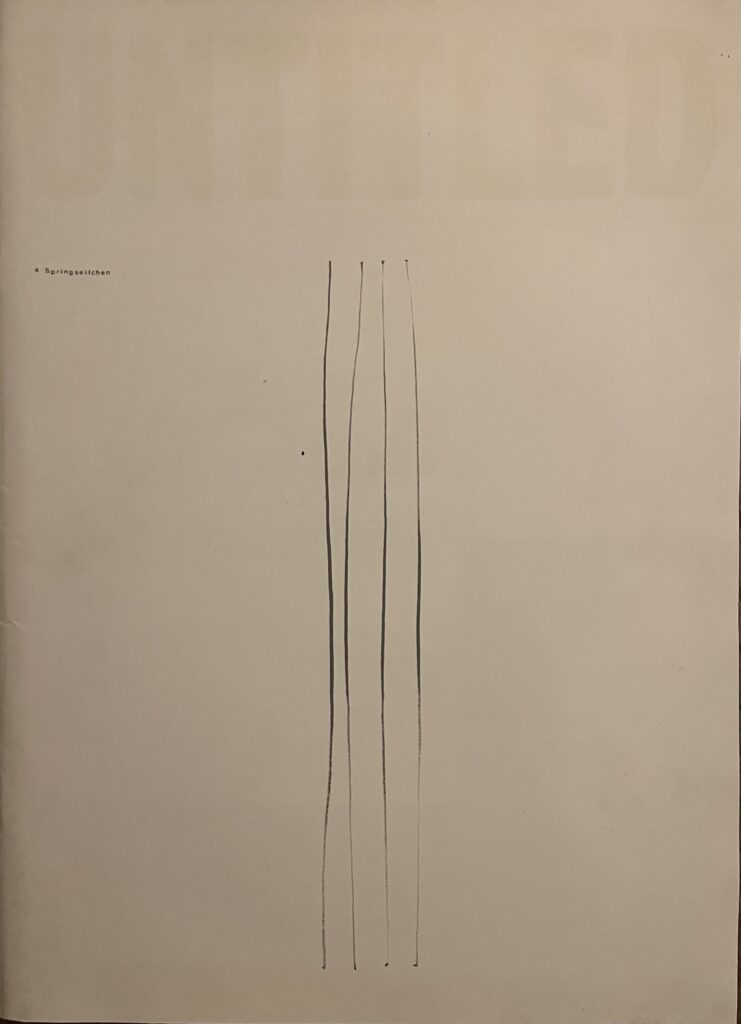
This review first appeared in the Spring 1999 Edition of Untitled Magazine whose cover is reproduced here.
Main image: Shells, Peter Greenaway webpage

Other Articles
Crónicas de M XIII: De lo que no se habla
El futuro por el suelo

No Comment! Be the first one.