

Por Ramiro Camelo
The disclaimer in question reads “Any resemblance to persons living or dead is not a coincidence” and it is in Mexican director Alfonso Cuarón first TV series ever: Disclaimer. Already known for his film adaptations of Dickens and Harry Potter books and for movies such as Gravity, Children of Men and Roma, this time Cuarón has completed a beautifully shot seven part series led by the intriguingly aloof Cate Blanchett
Some filmmakers seem to exist in a rarified space, where the ordinary rules of storytelling, logic, and cohesive narrative atmospheres no longer apply. Alfonso Cuarón has always been one of these. Films like Roma (2018), Gravity (2013) or Children of Men (2006) could be proof of that statement. Cuarón’s latest venture, Disclaimer, unfolds as a gripping thriller on Apple TV that masterfully weaves a knotty story. To reassure the miniseries best promotion possible Apple made a bold marketing stunt premiering Disclaimer in the 81st Venice Film Festival
Disclaimer is adapted from Renee Knight’s debut novel. She started her career in BBC arts documentaries and until becoming a fiction writer. The plot revolves around Catherine Ravenscroft, portrayed by Cate Blanchett whose roles are not strange of personalities being “cancelled” or morally abject. Recently In “Tár”, (2022), She played Lidia Tar, an unusual force of nature orchestra conductor who has a penchant for ill-conceived hubris and insolence. For her performance, Blanchet was nominated for the Oscars and won Best Actress at the Venice Film Festival, a Golden Globe. In FX/Hulu Mrs. America (2020), she starred as conservative activist anti-ERA ( Equal Rights Amendment) Phyllis Schlafly. Her icy demeanour portrait of Schlafly gained her widespread recognition and Golden Globe and Emmy nominations awards.
Ravenscroft is a successful documentary journalist who finds herself at the center of controversy following the unexpected release of the novel The Perfect Stranger. The book has effectively vilified her, exposing a past affair with a now-deceased 19-year-old named Jonathan, who heroically drowned while saving her four-year-old son. Flashbacks reveal a younger Catherine, witnessing Jonathan’s struggle in the turbulent sea waters, yet she refrains from calling for help. This exposure leaves viewers questioning her reputation and morality, adding a complex layer to the plot as the events progresses. Once the novel becomes a sort of bestseller, Catherine’s life begins to unravel into desperation and messy personal and professional life. Her actions are motivated by a mix of paranoia, self-doubt, and foolishness. What starts as an exploration of a woman’s search for the truth and redemption quickly escalates into a labyrinthine thriller where fact and fiction blur, and everyone without exception has an agenda.
The structure of the show is kept together using the strategy of the unreliable narrators, sometimes the voice-off of Catherine, sometimes the voice-off by other characters. Cuarón employs his trademark non-linear storytelling, fades out, to Italy holiday, fades in back to London in the present, viewers very soon will get used to it. In “Disclaimer” which starts as a very evident set of ‘truths’, for example, the readers of the book conclude that the protagonist in the book “She (Catherine) is a bitch!”, a phrase heard many times, soon becomes a fascinating dive into the realms of truth and deception until evolving into an intricately crafted house of mirrors. Cuarón knows how to maintain the narrative shifting and turning, and somehow keeping everyone guessing.
Cate Blanchett gives a breathtaking performance as Catherine, embodying a woman whose poise and self-restraint gradually unwind as tensions escalate. She is a woman who is, at all times, poised on the edge of something—a terrifying revelation, a moment of breakthrough or breakdown. Her portrayal is rich and layered, at some point she seems lost and defeated, however, she expertly conveys a delicate balance of vulnerability and strength in a human being haunted by her past.
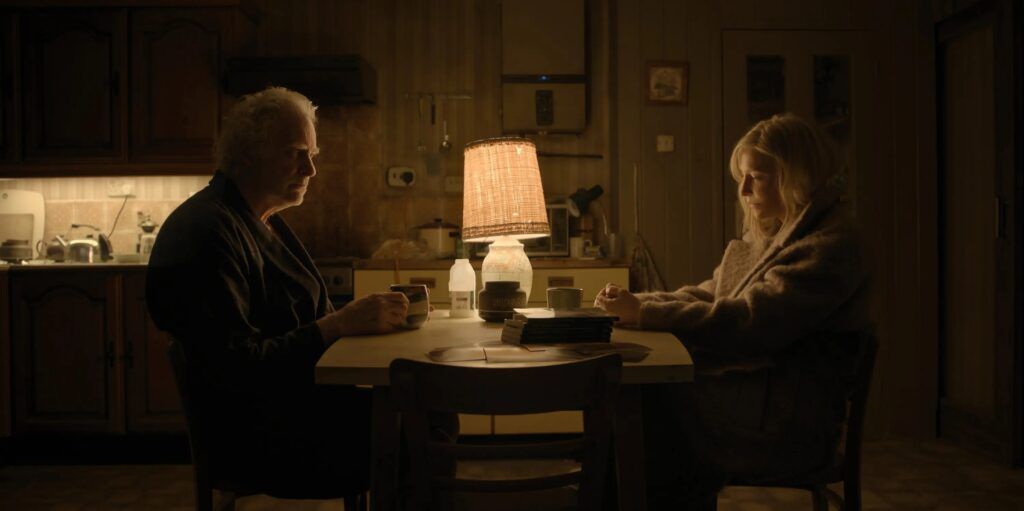
The supporting cast, including Sacha Baron Cohen, is convincingly cowardly and treacherous as Catherine’s posh husband Robert and the increasingly intriguing Kevin Kline, as Stephen Brigstocke, Jonathan’s father. Kline plays the enigmatic stranger who both complicates and elucidates Catherine’s unravelling story. In the last episode, they both will have an exhaustively painful confrontation sitting down across Stephen’s kitchen table. In that late night, Catherine fights her corner to gain a space and tell her version of the story. Her recount of events reframes almost everything the individuals in Disclaimer thought they knew. The shift in the show’s storyline compels viewers to reflect on their own opinions formed throughout the series length.
One of the most striking details of Disclaimer is its remarkable visual texture, led by the hand and eye of Cuarón’s vibrant cinematographer Emmanuel Lubezki. Cuarón, renowned for his sharp visual recounting (think of the seamless, continuous takes in Children of Men or the smooth cinematography of Gravity), has given this product a cinematic quality that often feels more like a film than a conventional television drama.
Disclaimer is a thought-provoking analysis of memory, revenge, and the complexities of facing the truth whatever is it. It raises the question of how much of our past is influenced by our interpretations compared to how others see it. The history delves into the imperfections of human memory and the potential pitfalls of unchallenged beliefs and prejudices that we all have. Additionally, it examines the contrast between our public images and private realities, illustrating how truth can be shaped for various purposes in the age of social media. To sum up, Disclaimer excels as a story that holds viewers spellbound right up to the final credits of the last episode. It might not grip you from the beginning, is a slow burn, but ends up as a captivating sequence of affairs that justifies its seven-episode run, offering a talented filmmaker as Alfonso Cuarón the opportunity to craft and deliver a sophisticated narrative that is perfectly tailored for the streaming audience.
Ramiro Camelo is associated editor of Perro Negro. He is a contemporary art curator trained at The Royal College of Art. He is currently based in Helsinki.
Read on other contributions by Ramiro Camelo for Perro Negro: Cyberpunk Rebooted, The Grumpiest Woman in New York, La biblioteca del futuro: escribiendo para lectores que aún no han nacido and The Best Sciencefiction Films of the Last 50 Years (in Spanish)


Cuentos de perro
A la sombra de la hechicera: releyendo a Michelet

No Comment! Be the first one.