

By Alessandra Migani
We are at the dawn of an African Century. It is the only continent whose population is still expanding and its cities are bustling centres of creativity, art and political ideas. In this note, art curator and writer, Alessandra Migani talks to the Lagos born, Birmingham based sculptor Abdulrazaq Awofeso about African identity, consumerism and the playful iconography behind his work
There is only one home to the life of a river-mussel; there is only one home to the life of a
tortoise; there is only one shell to the soul of man: there is only one world to the spirit of
our race. If that world leaves its course and smashes on boulders of the great void, whose
world will give us shelter?
Wole Soyinka
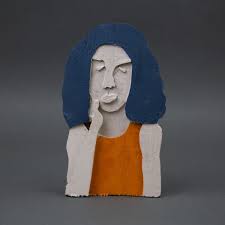
The first time I encountered Abdulrazaq Awofeso’s work was during the opening of African Metropolis: An Imaginary City, a contemporary art exhibition featuring works by 40 artists, curated by Simon Njami and Elena Motisi at the MAXXI Museum in Rome back in 2018. The installation, titled Behind This Ambiguity, occupied one of the museum’s pathways. The artist presented hundreds of small wooden statues, each representing a human figure, vibrantly dressed in ways that evoked African tribes, masquerades, and myths. As I approached the installation, I noticed how each character was meticulously crafted and
distinct from the others. It felt as though I could almost hear their sounds, their rhythms, their mixed voices narrating their unique stories. Awofeso had taken great care in orchestrating every single detail, like a conductor or a stage director. The installation left me enchanted.


To truly appreciate it, the eyes need time to adjust, transitioning from the broad perspective of the installation to the intricate details of each figure. A simple glance is not enough to grasp the life embedded in this work. It demands that you stop, step closer, and view it from different angles. This is the magic of sculpture: its three-dimensional presence creates a rhythm that engages not only the viewer but also the surrounding space, creating an immersive dialogue.
Since that first encounter, I have followed the evolution of Abdulrazaq Awofeso’s artistic journey, starting from his studio in Lagos, his hometown, to his various exhibitions and residencies around the world. Over the years, his work has grown in scale and ambition, with installations becoming increasingly striking and captivating. One standout example is his breathtaking piece at the Ikon Gallery in Birmingham, which featured over 3,000 figurines. The materials he uses, particularly wooden pallets, are deeply symbolic. Pallets, often discarded after being used to transport goods, resonate with themes of migration and
consumerism. They serve as a metaphor for the movement of commodities and people, carrying stories of displacement and journeys, echoing the lives of the individuals he portrays. In 2022, Awofeso relocated to Birmingham, UK, where he continues to create and exhibit his works. He recently concluded his second solo show at Ed Cross Gallery in London, and I seized this opportunity to reach out with a few questions about his artistic practice and vision.



When did you first realize that you wanted to become an artist, and what steps did you take to pursue and sustain a career in the arts?
While in elementary school, I used to make birthday greeting cards for my classmates for a token, I would also draw buildings around my hood. My father’s friend who’s an architect was the only person I could say was creatively inclined who would encourage me, he always commended my drawings by calling me “a born artist” . Those stages birthed my artistic interests up to secondary school where I opted for the art class, the rest as they say is history.
Do you recall ancient family stories related to your Yoruba culture? Rituals or ceremonies that might have influenced your work and research?
I’m from a very staunch Islamic home, with my late dad being an imam albeit his dad was a traditionalist. Growing up I never had any influence with the Yoruba spirituality, in fact I was more embedded in Islamic tenets than anything. However growing up with further exposure I have learnt to be more Liberal than before.


How did wood carving capture your interest and evolve into your regular artistic practice?
While in Johannesburg, the city of Joburg under the aegis of Artbank Joburg nominated me to partake in a sculpture workshop in 2009. That workshop sparked my interest in wood, from then I never looked back.
What kind of humanity do you aim to portray through your work?
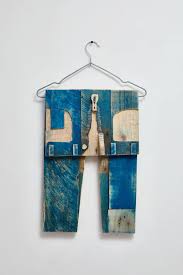
I love the freedom to explore and touch on matters I feel needed to. Humans are at the bane of my practice, furnitures and functional structures included. In 2017 I started reading a book titled Waste/A Philosophy of Things by William Viney. I’ve been reading and abandoning it repeatedly, so I recently picked it up again and have been assiduously concentrating on it to aid my research on humans, waste, time, and functionality. Through this, I’ve been able to weave humans, furniture, and dis/functionality into a model.
You were born in Lagos, spent 14 years in Johannesburg, returned to Lagos, and then moved to Birmingham (UK) in 2022. What is your connection to these three significant cities, and what do they represent to you?
All the three cities have somehow impacted my practice as they’re quite dynamic in their ways. The people, the experience, the culture are all ecumenical.
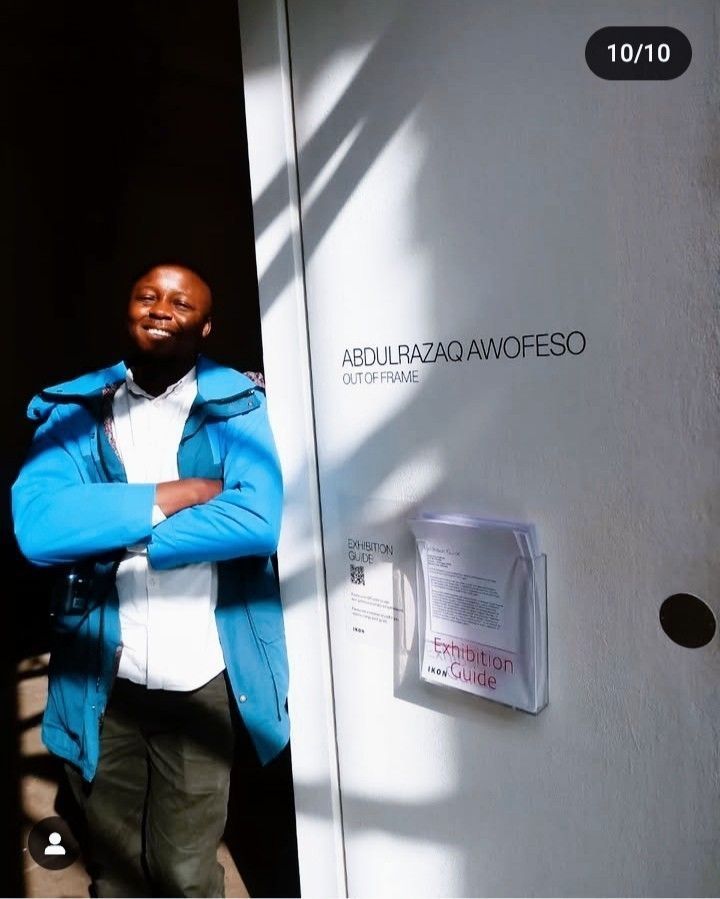
Your first solo show in the UK, “Out of Frame”, was held at the Ikon Gallery in Birmingham during the summer of 2022. How did you find that experience, and what challenges did you encounter along the way?
Getting a solo show at Ikon upon my arrival in the UK felt like I walked in straight up into the show from Lagos. Setting up a makeshift working space to meet up with the task at hand was like starting a new job, you have no other option than to put in your best foot forward.
How does your creative process work? How do you develop an idea? Do you start with a sketch and then develop it further in the studio?
I develop an imaginary visual sketch, then transfer onto my surface (wood) before I proceed to cut, dissect, assemble and disassemble until I get what I want albeit varies from project to project.
Do you have any artists you consider masters, or who have inspired you through art history books?
I love Tadashi Kawamata and Antony Gormley.
Since moving to the UK, you’ve had the opportunity to participate in various residencies. Could you share your experiences, particularly the one in Aberdeen, where you had the chance to experiment with printing while working closely with printmakers?
I was invited to participate in the residency at the Peacock studio as a part of their upcoming Aberdeen Bestiary exhibition to kick off a year later at the Aberdeen Museum and Gallery. It was my first time working fully with prints, the experience was great and educative as it gave me further insight to dig further into the art of printmaking with different techniques and applications.
Of the cities you’ve visited or spent time in during an exhibition or residency, is there one where you’d like to live?
Yes, Arnhem.
What does it mean to you being an artist? What is your message to the world? What are the questions you want to respond to through your work?
Just be yourself, the world will adjust.
Abdulrazaq Awofeso is a Lagos born, Birmingham based contemporary sculptor. His work has been exhibited internationally, including solo shows such as Out of Frame at the Ikon Gallery, Birmingham (2022), and Broad Streets and Akube Remix at Ed Cross Fine Art, London (2023-2024). He has also participated in significant group exhibitions, notably Lagos, Peckham, Repeat at the South London Gallery in 2023, where his work Avalanche of Calm was featured. Awofeso has honed his practice through residencies at the Thami Mnyele Foundation in Amsterdam and Peacock & the Worm in Aberdeen.
Alessadra Migani read Literature at La Sapienza University in Rome. Her graduation thesis was a research on the history of music videos and their intersections with cinema. She has collaborated in festivals such as Enzimi, Rome, and Onedotzero, London. In 2011 she directed the art gallery Contemporanea in Rome. Her curatorial work includes researches on expression of African diasporic identity through photography, video art, and site-specific installations. She writes about art for various online magazines and this is her second piece for Perro Negro. She lives in the Italian capital.
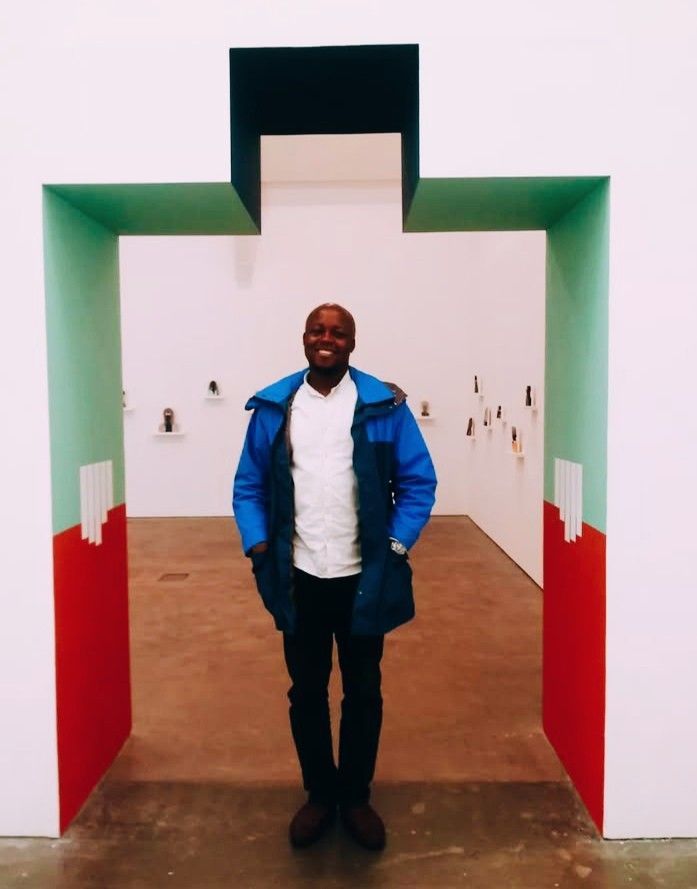
Images: Principal, Avalanche of Calm, South London Gallery. Inside the article; Behind This Ambiguity 2015-2018, MAXXI, Rome, 2018; Details of Out of Frame and Fragments of a City, IKON Gallery, Birmingham 2022; Photos of the artist by Alessandra Migani


¿Malvinas o Maldivas? That’s the Question
Seven Times León de Greiff

No Comment! Be the first one.