

By Jorge Chartier
The British-Chilean painter Pato Bosich, is now being recognised in many corners of the world with exhibitions in Europe, the Americas and, most recently, Asia. His work is a dialogue steeped in many traditions of Western painting including surrealism plus more than a dash of the chaotic, sacred and perverse vision of Hieronymus Bosch, This note is a truly panoramic view from Bosich’s studio in London in anticipation of his second exhibition, in November 2025, at the Art and Talking Gallery in the mythical Cotswold of West Oxfordshire
A quick orientation for the wandering eye
One night—idyllic, gently dislocated, as if slipped from time—I found myself drifting through the world of Pato Bosich, not by walking through his door, but by entering through his images. The visit began online: a slow, attentive gaze through his website, where towers rose like spinal columns, cities bent into labyrinths, and sea-creatures blinked with metaphysical mischief. Symbols floated without anchoring, yet everything pointed unmistakably toward the studio—the brickwork sanctum, the spiral mind-fortress. I hadn’t entered yet, but the door was ajar.
When I finally did step inside—into the high studio-tower, a space equal parts citadel and observatory—I arrived to find a new collection in flux. The walls breathed with works still forming: oil, smoke, architecture, myth. The studio was not still; it was mid-incantation.
This exercise is the result of that encounter: a series of descriptions, reflections, and quiet navigations through Bosich’s visual cosmogony. I begin with an essay for three works from Infra Omphalos (2024)—a triptych that forms both a myth and a mirror. Then, I move through his current exhibition, The Man in the High Castle, now inhabiting Art & Talking in Chipping Norton—a show that lets the tower travel. Finally, a few steps closer to the artist himself, including a 2021 podcast for Spanish listeners, in which Enrique Zattara charts the long road Bosich walked from Chile to the United Kingdom.
This is not a biography. It’s a map drawn in fog. But if you follow the spiral, you may find the tower.
§
Infra Omphalos – Three Incantations from the Tower
Thaumaturge at the Crossroads
At dead-centre a colossal traveller shoulders his studio-tower as if it were a pilgrim’s staff. Down his flank the brick spiral stair bleeds red into his loins, while blue starlight pours into the grasping hand: a chromatic tug-of-war between Dionysian appetite and Apollonian reach.
Two stylite saints—thin columns of resistance—flank the giant, their vertical stillness bracing the picture’s torque. Below, a lion-headed courtyard and a crescent of terraced houses rearrange London into a copper labyrinth, Cheshire-Cat familiar yet unplaceable. Above, twin omphali—studio floor and cloud-vortex—loop into a lemniscate: as above, so below. The sky appears to inhale the street, or perhaps the hero exhales the cosmos. Even the moon plays a trick, masquerading as the Earth while a tarnished orb hovers where a moon should be.
Juxtaposition of symbols without altering their position: divine and profane, dawn and dusk, disaster and stillness occupy the same co-ordinates without collapse. Time, too, is unpinned; no shadow settles long enough to declare an hour. And so we ask, with the painter, where are we?
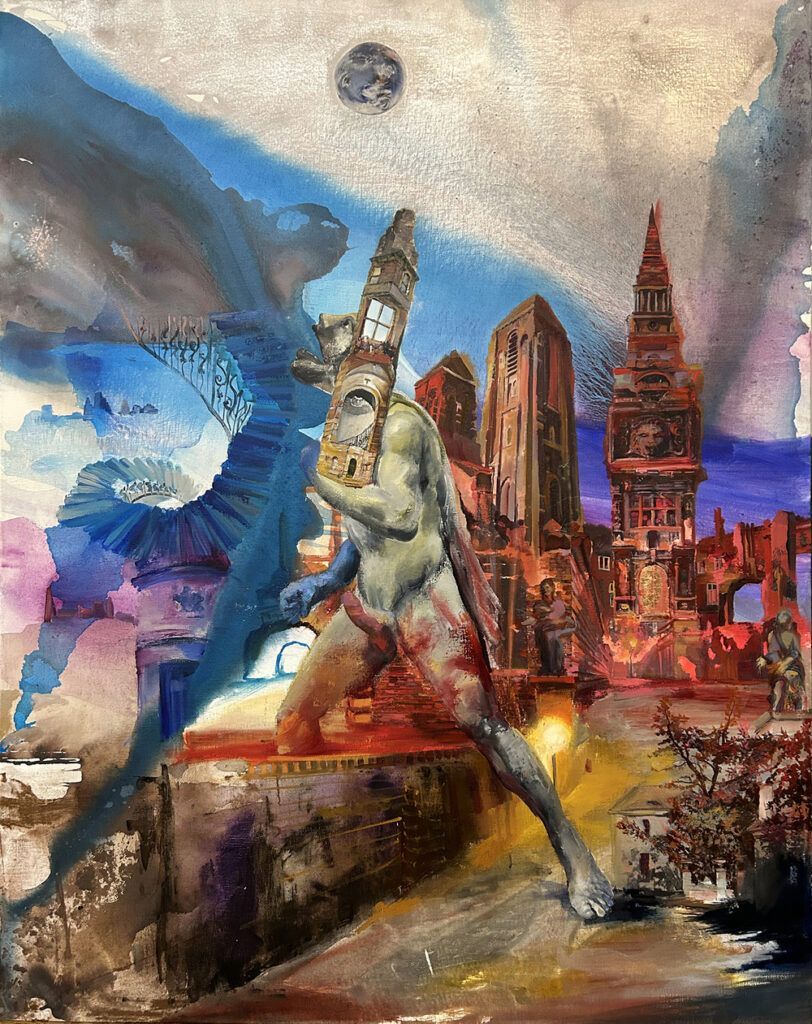
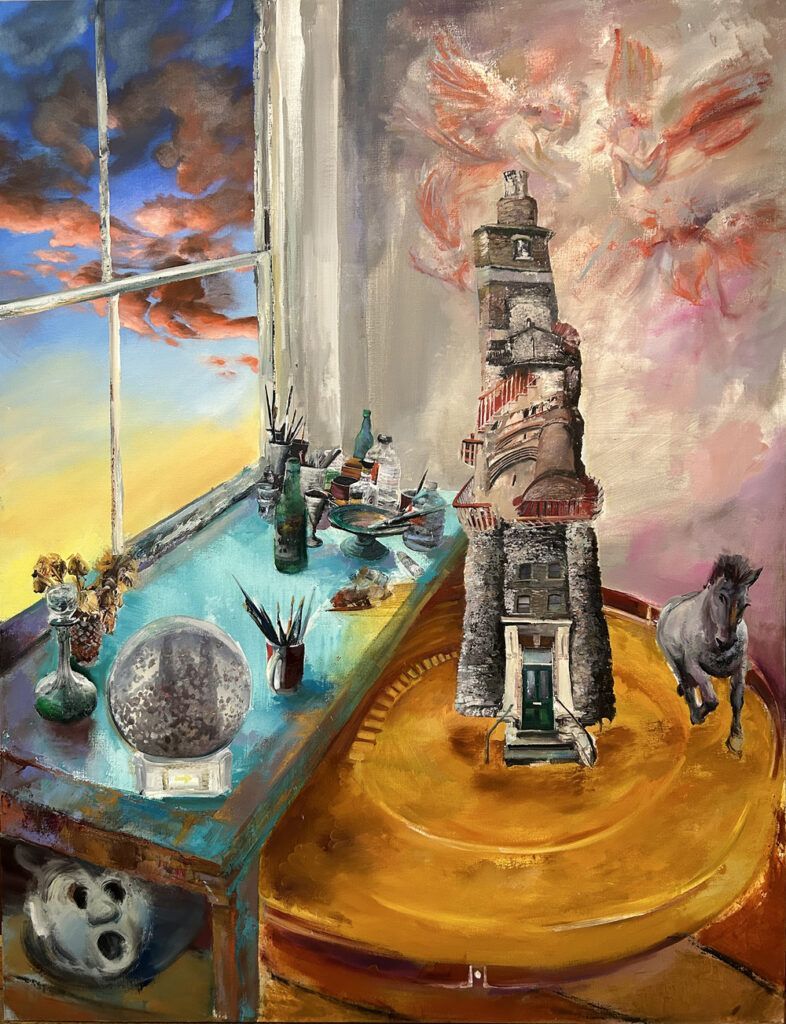
Magical Equilibrium
Here the tower hovers over a sandy bull-ring—omphalos turned circus—while a black horse canters around its rim, kinetic avatar of artistic will. Inside the studio we see the humbler instruments of alchemy: jars, mediums, a clutter of paint tubes glowing arterial red. On the work-table sits a crystal-snow-globe that imprisons yet another tower, winter-lit—a mise-en-abyme of making.
Architecture grows anthropomorphic: window-eyes, bannister-arms, a belly-button aperture through which inner light leaks. Angels—or are they transmuted clouds?—drift above the tower’s crown, echoing the evening sky framed by the studio window. Symbols speak across registers, keeping what the painter calls “magical equilibrium.” Break the balance and, as the younger critic spotted, a horned demon skulks beneath the table ready to pounce.
Shadows do much of the metaphysical heavy lifting. One cast on the ground confirms levitation; another, stretched across beached vessels, asserts an ordinary sun. Two irreconcilable systems coexist, sealing the pact between the beautiful and the disquieting.
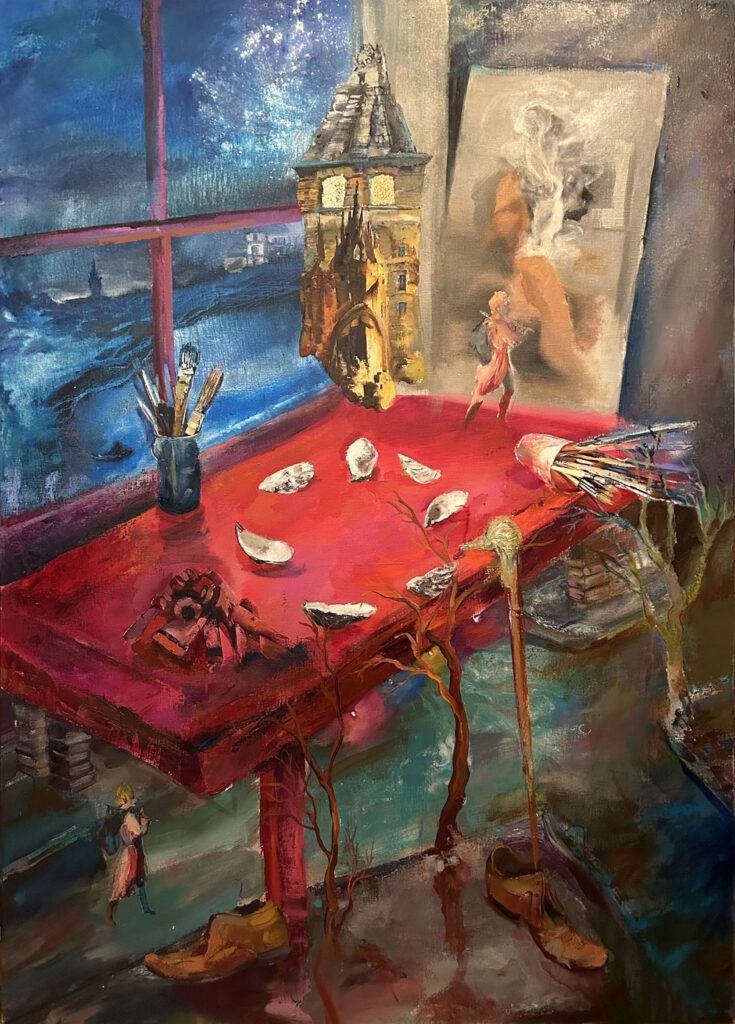
Conjuring of the Tower
The trilogy’s opening panel is also its genesis myth, painted like a stage set for animated objects. From scattered tools, seashells and oysters, Bosich raises a golem: the levitating tower for a head, brushes for hands, walking stick for legs, desk-legs for tibias, a Mayan pyramid for a thinking cap. Twin windows—one clad in gold leaf, one in copper—glint “like two suns,” dazzling the viewer and illuminating yet another painted city within the tower’s walls.
Spatial logic pirouettes. A glass tumbler holds feathers, a knife and a fork; wind appears to blow from inside the picture toward the spectator. A mirror on the table reflects only smoke, concealing the artist’s face while suggesting he might, Pascal-like, occupy every point of his own spiral. A miniature journeyman steps toward that mirror and simultaneously trudges across the wintry crossroads beneath the furniture—a split second suspended across parallel worlds.
The Spanish account calls the painting “a puzzle” and locates its true address in “nowhere… or at an absolutely intermediate point”, the navel of the spiral. Bosich would likely agree: the omphalos is both workshop and cosmos, and the tower both fortress and body. To stand inside is to be, for a moment, removed from the world and yet radiantly at its centre—the artist as lighthouse keeper.
§
The Man in the High Castle – A Painter’s Fortress in the Cotswolds
Front Façade – The Wall of Portals
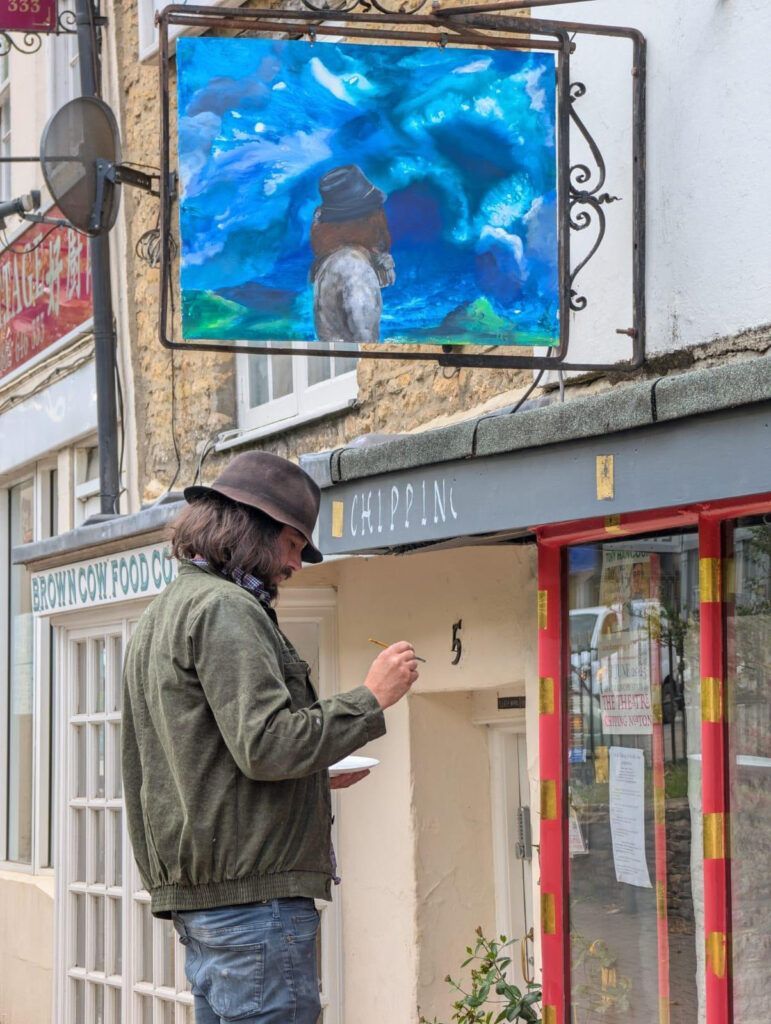
The exhibition begins before you even step inside. Covering the building’s street-facing wall is a powerful ensemble of paintings that blur the boundary between public street and private myth. Much like Bosich’s motifs—towers, skies, horses, dreams—this open gesture invites and challenges, standing as a physical manifestation of the “studio at the centre of the cosmos”.#
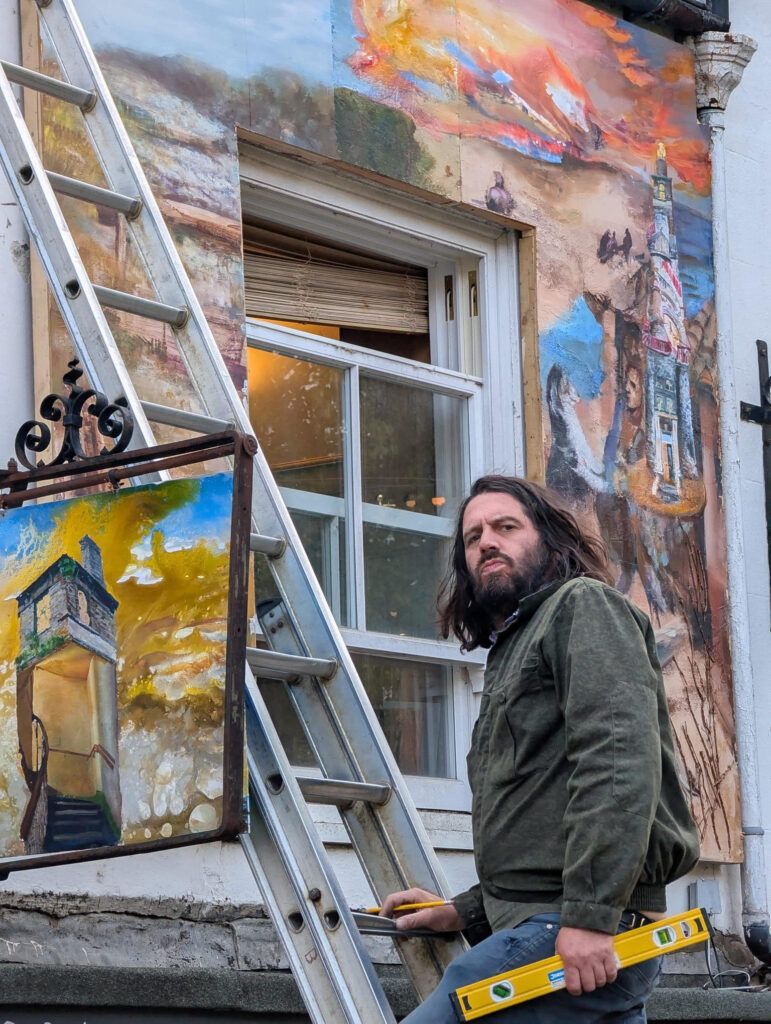
Double-Sided Shop Window Sign – A Shifting Axis
Suspended in the shop window is a pivoting sign bearing a painting on each face. One or the other could be the same man, the same tower. Neither tell the story, both are an invitation to enter.
Main Lounge – The Core of the Spell
At the centre of the space, the lounge holds a main canvas called El desdichado I surrounded by eight smaller works circle the main piece like satellites, forming a ritual choreography of Bosich’s motifs. Each painting amplifies the studio’s metaphysical engine.

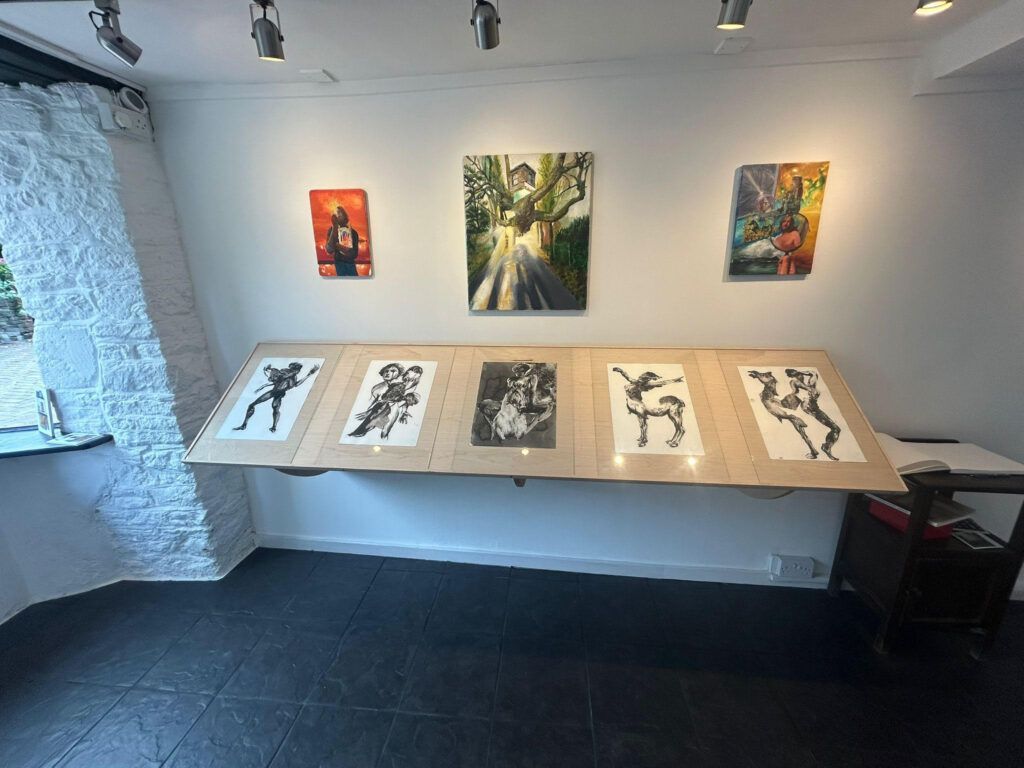
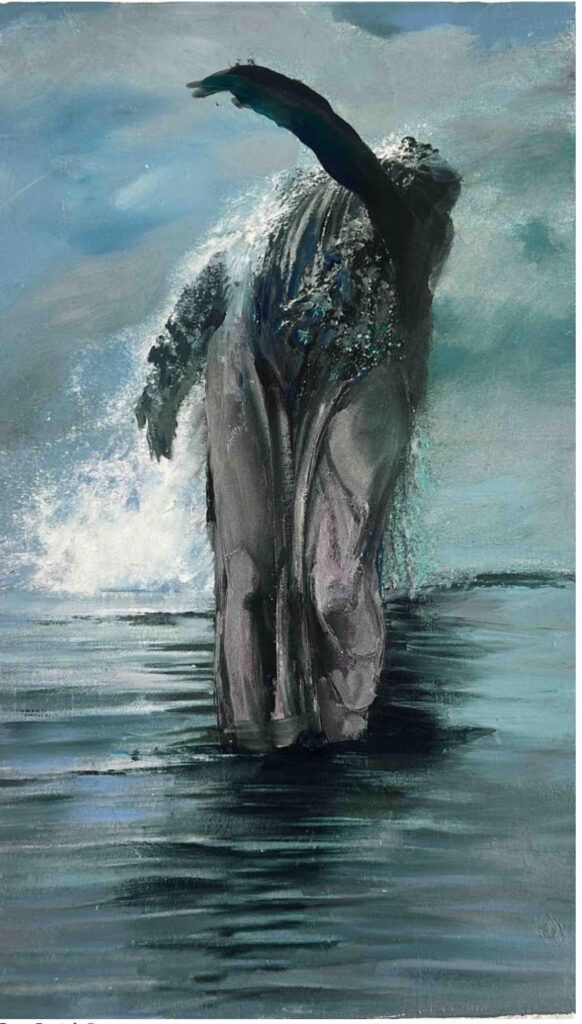
The intimacy of the exhibition makes it ideal for Bosich’s drawings. Here, detail becomes a philosophy. We see preparatory studies for shapeshifting bodies, stylite saints and cloud-angels in raw line. They whisper the underlying geometry of the larger works.


§
Room 2 – Four Paintings, Four Variations
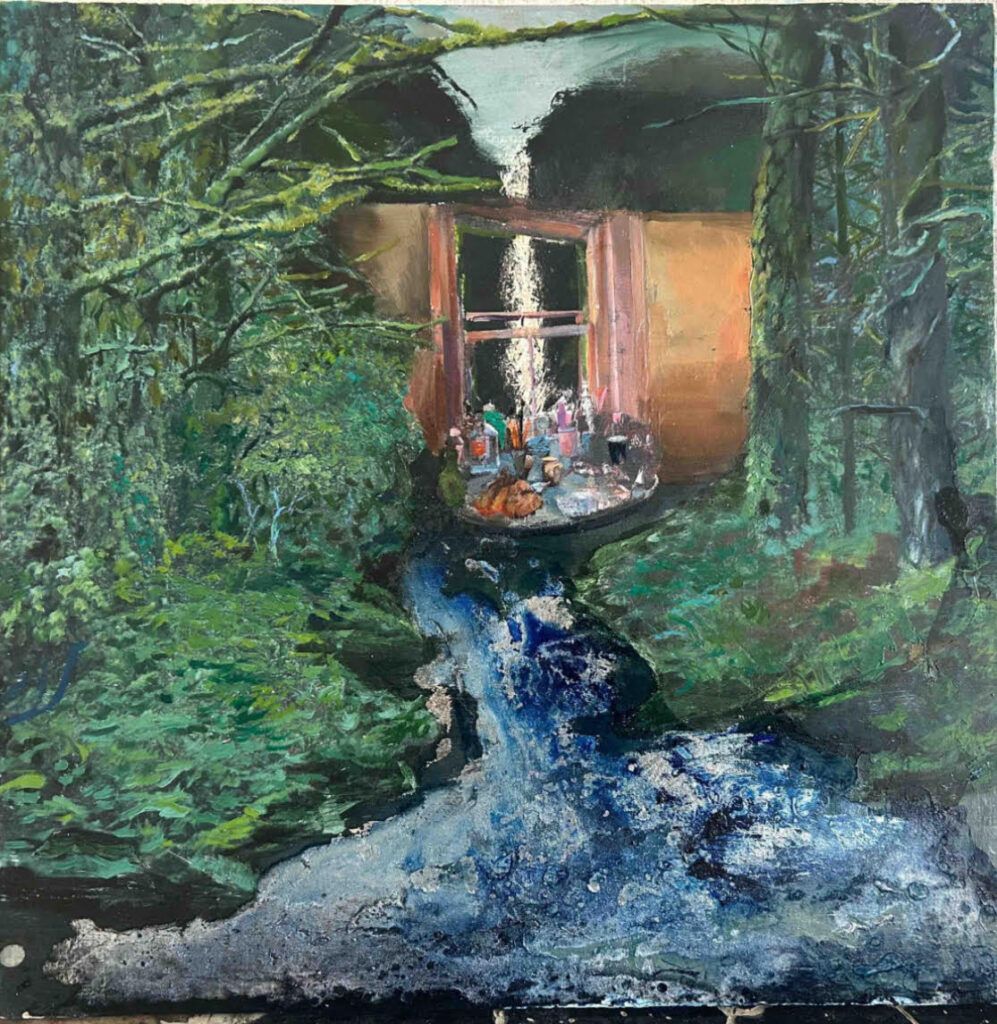
In the final room, four paintings gather like council members. They echo and morph elements from nature and dreams. There’s a sense of descent—or ascent—depending on your narrative thread.
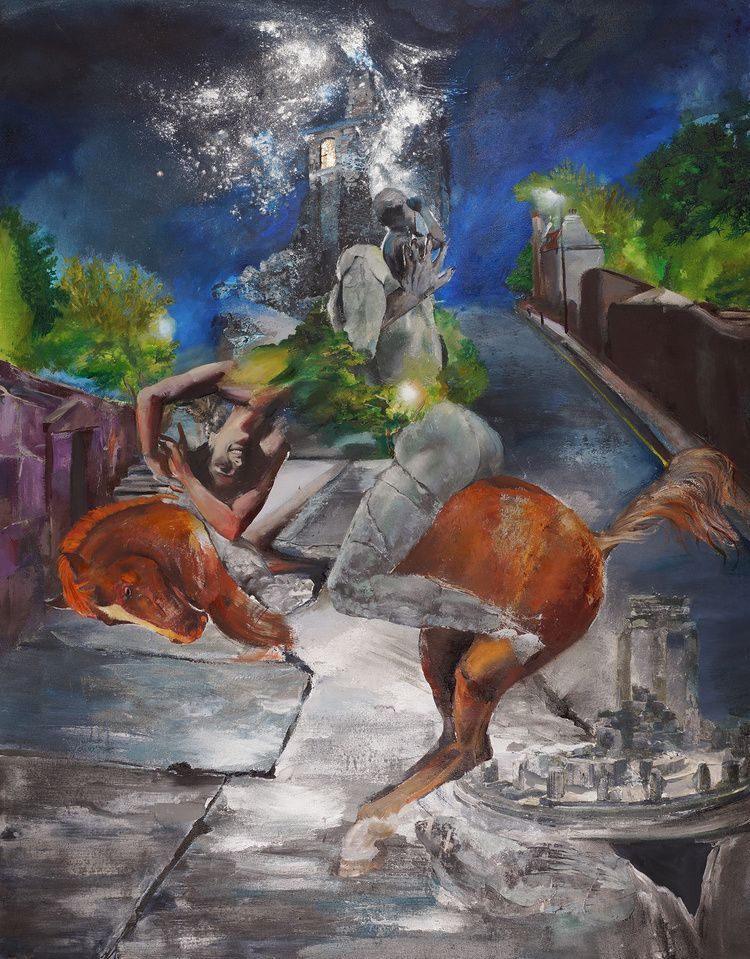
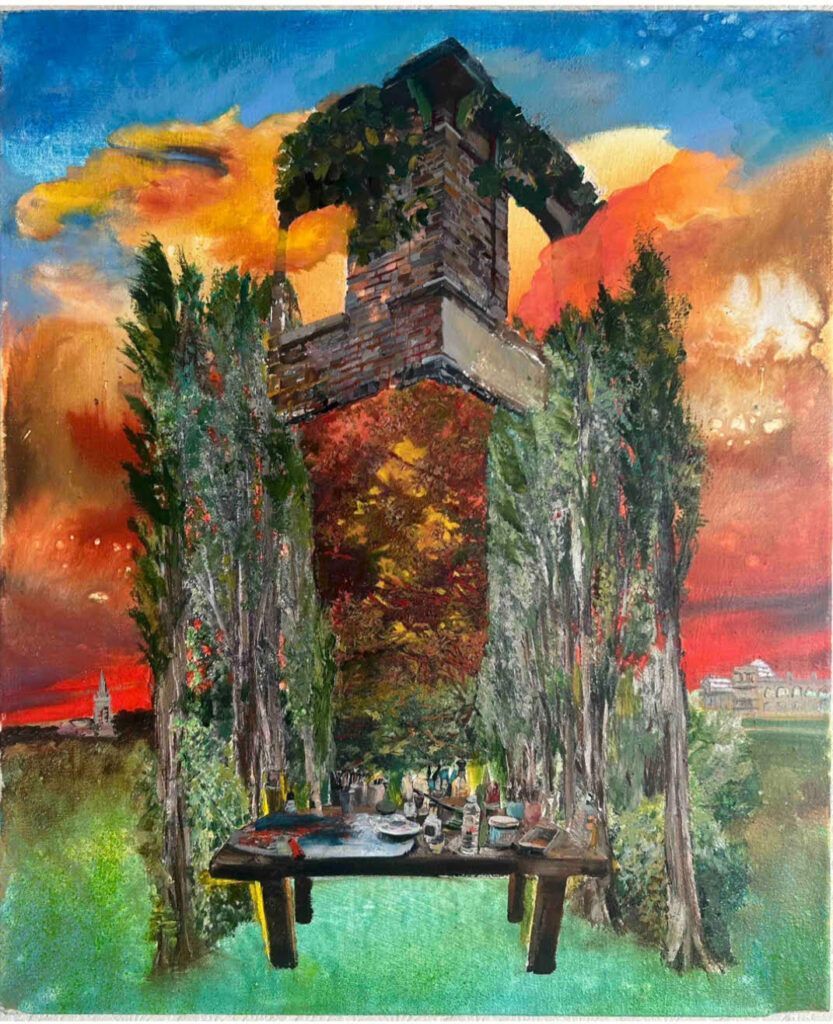
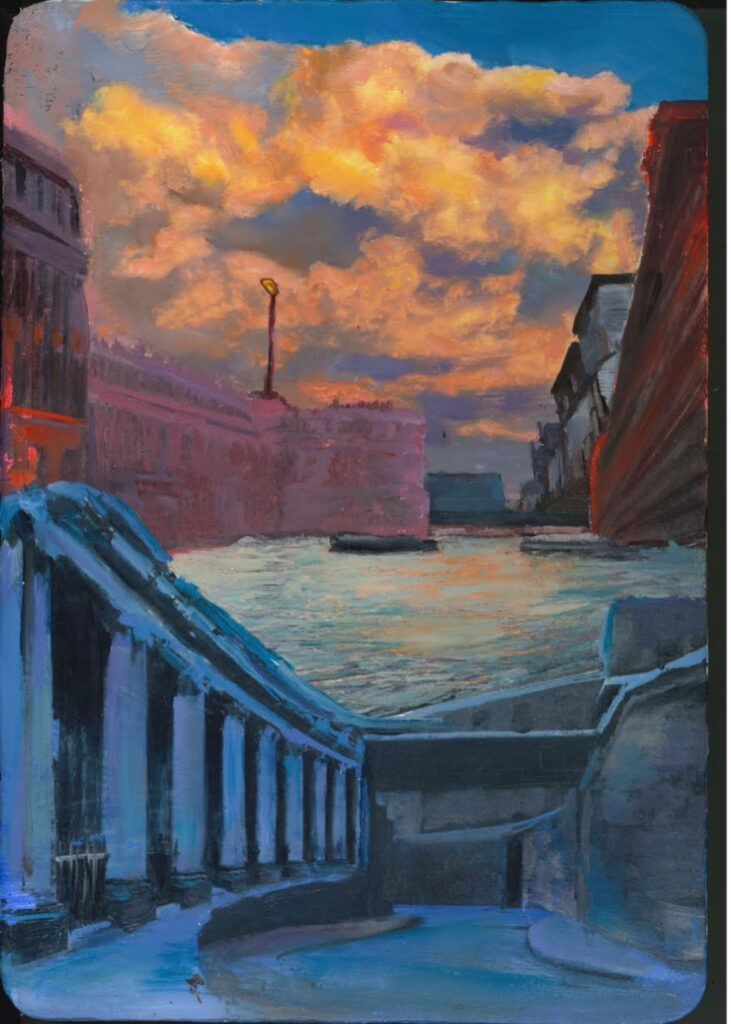
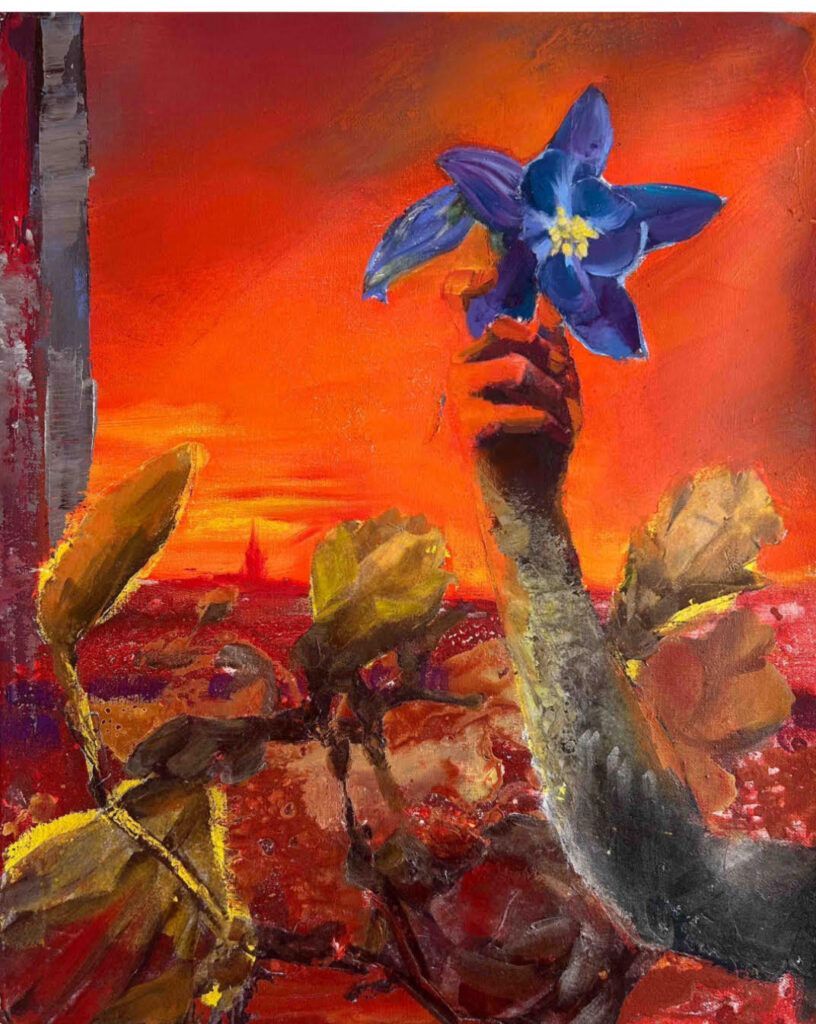
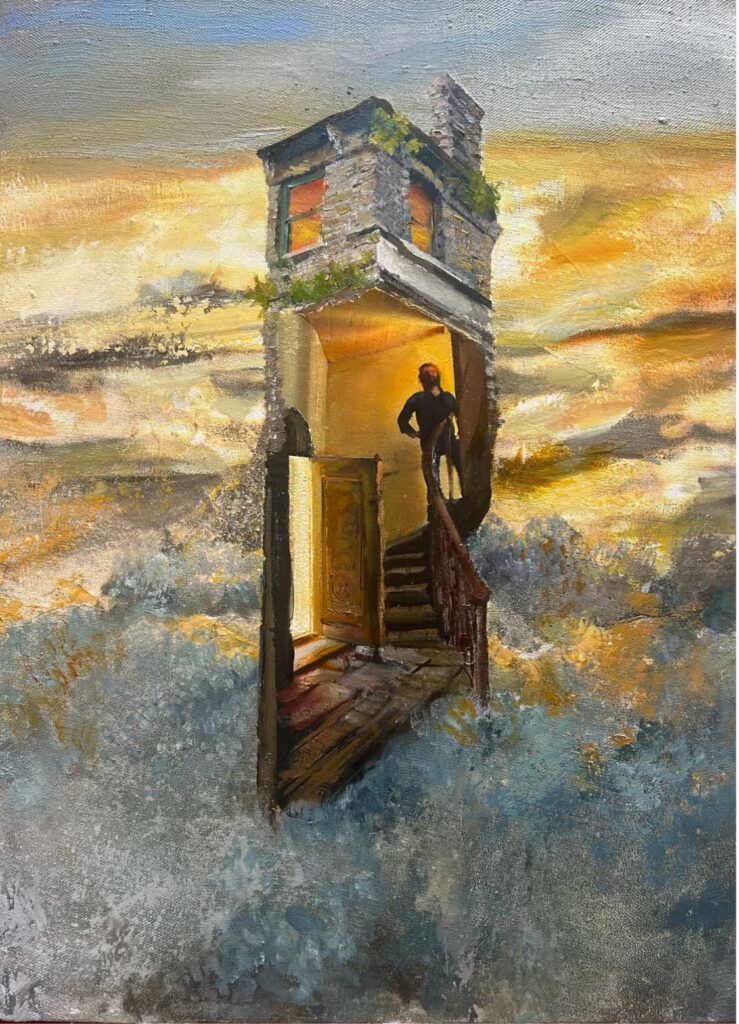
This exhibition offers more than a sequence of paintings—it builds a territory. Viewers walk not just from room to room, but from symbol to symbol, from metaphysical problem to psychic riddle. As Bosich might frame it: we stand not outside the tower, but inside its winding core. We are, for a moment, part of the studio’s dream.
About Art & Talking
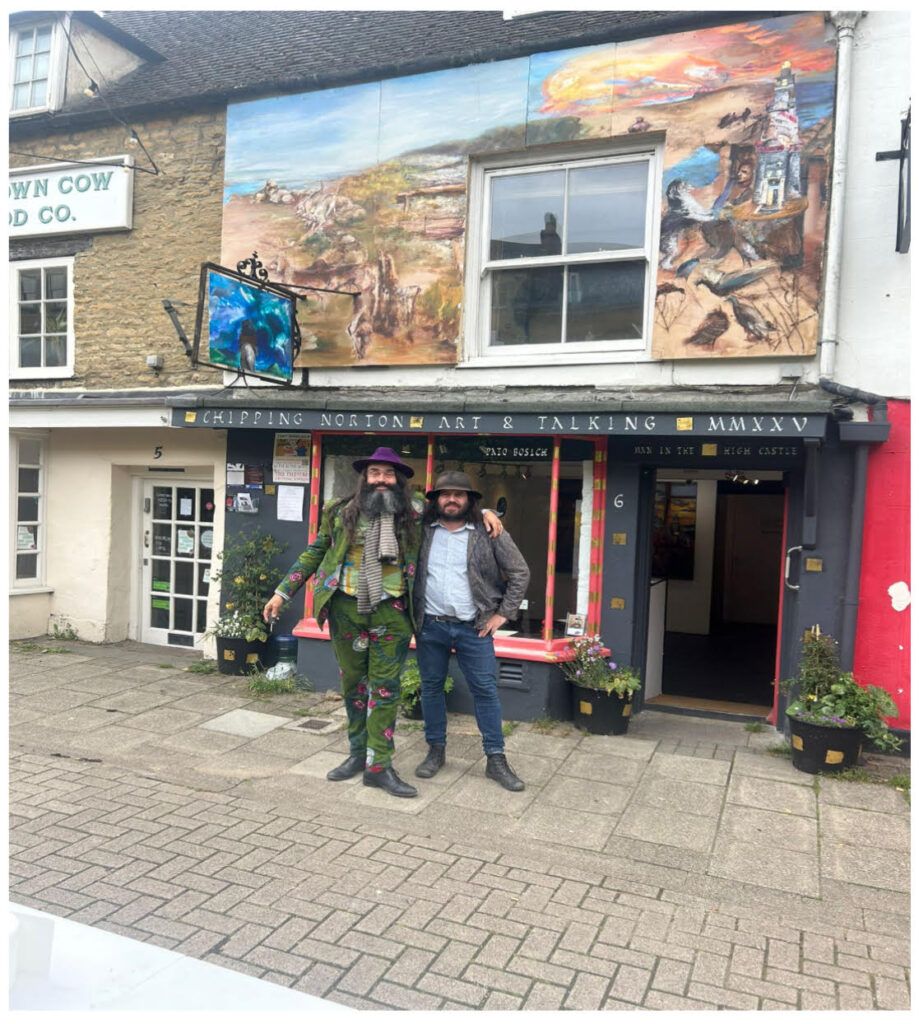
Art & Talking is a hybrid gallery, creative shop, and cultural salon in Chipping Norton, Oxfordshire. With roots in Berlin and Venice, the space merges exhibition with dialogue, community with experimentation. At its heart is a belief in artistic exchange across geographies and languages—making it an ideal partner for Bosich, a Chilean artist long based in the UK, whose work stretches across continents of form and myth.
§
About the painter
Pato Bosich (Santiago, 1978) is a Chilean–British artist based in London. A graduate of Camberwell College of Arts (2004), Bosich’s work has traveled widely—exhibited across Europe, Latin America, the United States, and Asia. Recent solo exhibitions include Kunstenfestival Watou (Belgium) and Sun Gallery (Seoul).
His practice is steeped in dialogue—with antiquity, mythology, the British Museum’s archives, and the symbolic heritage of Western painting. But his images are never static: Bosich refers to his method as a kind of “artistic time-travel,” where classical echoes collide with the metaphysical undercurrents of contemporary life.
For those wishing to step further into this artist’s journey—from Santiago to London, from Bosch to the Tower— pelase visit his webpage plus there is a luminous conversation worth hearing. In Episode 18 of the podcast El Ojo de la Cultura, Argentinean critic and writer Enrique Zattara speaks with Pato Bosich from his London studio. Their dialogue traces the painter’s personal and artistic trajectory, circling around the themes that haunt his canvas: exile, metamorphosis, the persistence of the symbolic. The episode opens with a reflection on the legacy of Hieronymus Bosch, whose 16th-century visions—chaotic, sacred, perverse—find new resonance in Bosich’s dream-logic world. Woven through the conversation is a reading of a poem by Juan Ramón Jiménez, acting as both compass and counterpoint. Worth mentioning again, the podcast is in Spanish. Another podcast about the work of this artist, this time in English, is Pato Bosich: The Accidents of Colours and Forms on ZTR Radio.
Jorge Chartier Navarrete is a poet, shot story writer and a philosophy enthusiast. Born in Santiago de Chile in 1989 he graduated as a civil engineer from Pontifica Universidad Católica de Chile and then obtained a diploma from Stanfrod University School of Business. His most recent book is a collection of poems called De la pluma de la vida, by Ojo de la Cultura editorial. His various contributions for Perro Negro can be read here
List of works as they appear: main image: El desdichado I (2024). In the article: Thaumaturge at the Cross Roads (2023), Magical Equlibrium (2023), Conjuring the Tower (2023), Bosich painting the exterior of Art and Talking Gallery in the Cotswolds, West Oxfordshire and El desdichado I (2024). Inside the gallery: Keeper of the Castle (2025), These Arms of Mine (2025) and Prince of Aquitine (2024). The triunvirat of oil paintings include: Dream of The Cave III (2025), The Man in Higher Castle (2024) and Woman Whale (2025). Untitled Drawing 2024-2025. Four Pantings, Four Variations: Horse Hero in North London (2022), The Painter’s Table (2024), The Resurrection of The Tyburn (2025) and Aquilegia (2025). Last photo: the artist with Michael Bucknell, founder of Art and Talking.
For more information on Art and Talking‘s present and forthcoming exhibitions plus talks, click here

Other Articles
La crisis del lenguaje en la Viena fin-de-siècle.
No Comment! Be the first one.