

By Professor Jason Wilson
One of the most charismatic and beloved of Latin American writers was neither born in nor died in Latin America but in Europe. In the 1970s he was our literary rock star. A superb short story teller who consider reading a revolurtionary act hence the ludic and daring aspects of many of his tales and novels. This is the first instalment of two examining the nature and themes of his prose
Julio Cortázar, the Argentinian writer, was born in Brussels in 1914 and brought up from the age of four in Buenos Aires. He studied briefly at university and then taught at a school and at the University of Mendoza until he clashed with Peronist authorities and resigned. He then trained as a translator and interpreter and won a scholarship to Paris where he remained until he died in 1984,
His earliest published work consisted of critical essays (on Keats, Rimbaud, Artaud), and poems under a pseudonym, ‘Julio Denis’, He matured as a writer under the shadow of Jorge Luis Borges and Sur, the cosmopolitan literary magazine edited by Victoria Ocampo, and only relatively late found the medium for his surprising originality.
He published his first collection of finely crafted and jolting short stories the year he left for Paris and called them ‘Bestiary’ (Bestario, 1951). He followed these with seven subsequent volumes: ‘Secret Weapons’ (Las armas secretas, 1959), ‘The End of the Game and Other Stories’ (Final del juego, 1965), ‘All Fires the Fire’ (Todos los fuegos el fuego, 1966), ‘Octahedron’, (Octaedro, 1974), ‘Someone Who Walks There’ (Alguien que anda por ahí, 1977), ‘We Love Glenda So Much and Other Stories’ (Queremos tanto a Glenda, 1980) and ‘Awkward Moments’, (Deshoras, 1982); many ably translated into English.
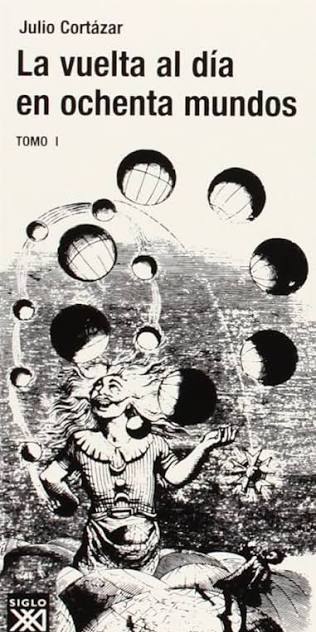
Cortázar’s first novel ‘The Winners’ (Los premios) was published in 1960, followed by ‘Hopscotch’ (Rayuela, 1963), ’62: A Model Kit’ (62-modelo para armar, 1968), ‘A Manual for Manuel’ (Libro de Manuel, 1973) and ‘A Certain Lucas’ (Un tal Lucas, 1979). His poetry first playfully appeared as Pameos y meopas (anagrams of the word poemas — poems), 1971, and ‘Except Dawn’ (Salvo el crepúsculo, 1984). Interspersed with these are Cortázar’s less classifiable, experimental works ranging from ‘Cronopios and Famas’ (Historias de cronopios y famas, 1962) to collage books like ‘Around the Day in Eighty Worlds’ (La vuelta al dia en ochenta mundos, 1967), and ‘Last Round’ (Último round 1970), or his journey down the autoroute from Paris to Marseilles Los autonautas de la cosmopista (a play with words: auto-car, astronauta-cosmos and autopista-autoroute, 1983). And finally his political writings have been collected under Nicaragua so violently sweet’ (Nicaragua tan violentamente dulce,1984), and ‘Argentina: Years of Cultural Wirefencing’ (tadoArgentina: años de alambradas culturales 1984).
Behind all his works Cortázar employs an impressive skill in engaging the reader in a world of subtle and sudden jolts. He learnt from the French Surrealists how to shake the lazy reader into an awareness that something threatens behind the conventions of everyday life without ever defining this elusive, often hostile otherness. And behind Cortázar’s multi-faceted work lies a restless youthfulness, even dissatisfaction, that invokes both intense seriousness and black humour, that refers to Zen, modern jazz and revolutionary politics in a supple prose that hints at a moral vision of the self’s repressed potential, both individually and collectively. Over his later years Cortázar became more and more radical, but the turning point was undoubtedly the Cuban Revolution of 1959. He worked selflessly for the Russell Tribunal and later Sandinista Nicaragua, often giving his royalties to the causes he fought for.
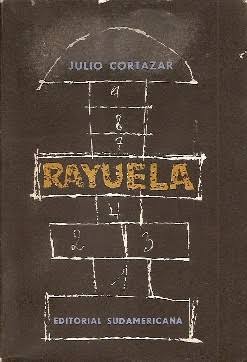
Looking back over his published work a defiant integrity emerges as one of its constants. As a writer Cortázar refused to be catalogued and like a juggler combined impeccable, hypnotic short stories, novels that undermined the illusions of realism, nostalgic sonnets and whimsical surrealist collage books with earnest essays on Latin American politics. But rather than account for this exhilarating defiance through his varied books, Rayuela (translated as Hopscotch, 1967) will serve as a compendium of his ramifications. Hopscotch calls itself both novel and anti-novel, it has sections that read like stories, lyrical passages that approximate to poems and experimental set-pieces that mix eroticism, wordplay and black humour in debts to Jarry, Dada and Henri Michaux. Hopscotch is also an elegy to omnivorous reading.
As a writer Cortázar was haunted by Western culture’s fascination with revolutionary change. Put as simply as possible this dilemma questions whether a person can change or escape himself and stand in somebody else’s shoes, in their skin. Is freedom attainable? This quest for a radical rebirth, symptomatic of a dead-end civilization in its death throes, implies the dilemma of Otherness and how other is the other. But rather than get ensnared in generalities, let us begin with the protagonist and possible narrator of Hopscotch, Horacio Oliveira, and his experience of intense dissatisfaction with things as they are (the stereotypes he inherited) and the consequent trickiness of facing up to himself without self-deceit or selfjustification. The novel is a mirror of his attempt to be himself and this mirror is a metaphor of self-analysis, a substitute for psychoanalysis.
But before entering the Pandora’s box of Hopscotch, as Carlos Fuentes once called it, a few contexts will help define Horacio Oliveira’s cultural disease of self-revulsion. The crucial antecedent for Cortázar was Surrealism as a utopian praxis that set out ambitiously to change inner man and society. In 1935 André Breton prepared his speech for the Writers’ Congress (which he wasn’t allowed to read) with a challenge to fuse Marx’s ‘transformer le monde’ with Rimbaud’s ‘changer la vie’. Cortázar absorbed this call but brushed Marx aside because he felt that an inner change in the individual preceded a change in the collectivity, Throughout the 1950s in Paris, while amassing the notes which ended up as Hopscotch Cortázar dabbled in the fashionable Zen and Vedanta which both stressed the individual’s need for an inner change. But Rimbaud had become an early culture-hero. In 1941, under the pseudonym Julio Denis, Cortázar wrote an article claiming that Rimbaud’s poetry and then radical change to Red Sea adventurer had become both a ‘message’ and a ‘warning’. Reading Rimbaud had generated an inner model of a double kind of authenticity, both literary and existential which was hard to live up to. Cortázar adopted various culture-heroes, best embodied in Artaud whom he described on his death in 1948 as having attained ‘the highest and most difficult grade of authenticity’; and in Charlie Parker, fictionalized in a story ‘The Pursuer’ (El perseguidor) where the black alto sax player’s quest for authenticity ‘denounces us all’, However, what confuses Cortázar’s admiration for such extremist culture-heroes is the fact that he had read (or listened to) them.
Cortázar never resolved the ambivalence he felt about reading. To Omar Prego, Cortázar described the protagonist of an early novel only published posthumously as El examen (‘The Exam’, 1986), as autobiographically a ‘superlector’ which I will interpret as the Borgesian disease of over-reading, a toxin affecting Cortázar’s Sur magazine generation. It was reading as a child that first initiated Cortázar into the miracle of transference from his banal hometown reality in the Banfield suburb of Buenos Aires into the magic, dangerous and adventurous world of Salgari and Jules Verne. This change took place in his fertile mind as he held a book open and read; a kind of hypnosis, even brain-washing. Years later (1980) he confessed to Sara Castro-Klaren that reading still ‘lifts me totally out of everyday life, my way of being and way of thinking’. In 1983, just before he died, he told Prego that he could still ‘sink himself’ into a book and that reading allowed him ‘to change places, leave myself behind, move to another context’, But as all readers know, especially with a novel’s cunning illusions of a parallel, realistic universe, there comes a moment when you have to crash out of this ‘alternative’ world and return to banality. Answering Prego, Cortázar remembered his rage as a nine-year-old reading his favourite novel when an aunt shouted ‘Julio, your piano lesson!’. He called this return to the empiric self before the release (and relief) of reading, a bitter disenchantment.
Of course many other experiences shift us out of the humdrum – sex, drugs, trances, revolutionary politics — but the prime metaphor for radical change in Cortázar’s case remained reading. However, the thrill of being ‘elevated’ into another mental realm while reading generated a counter-effect that led to a resentment at being hypnotized, for reading also smacks of escapism, privacy and élitism. So Cortázar learnt to discriminate between escapist reading and genuine reading where Rimbaud and Artaud became his way of testing other authors (and himself). Here the novel more than any other genre epitomized his ambivalence. So Hopscotch narrates the descent into hell (Rimbaud’s not Dante’s) of a middle-aged Bohemian who discovers that the hypnosis of reading and culture is a fraud. This recasts Don Quixote with the bourgeois realist and psychological novel substituting the chivalry novel.
Cortázar’s ambivalence about whether reading promises a revolutionary change in being points to a proviso: it depends what and how you read and whether you are a bourgeois male novel reader or not. The perplexing opening story of ‘The End of the Game and Other Stories’ (Final del juego, 1964), called ‘The Continuity of the Parks’ (La continuidad de los parques) opens with a busy man reading a novel in an armchair in his study overlooking his estancia, park. He loses himself in the novel’s plot and characters: ‘novelistic illusion wins him over completely’. Suddenly he becomes one of the characters and creeps up behind himself with a knife. Moral: it is dangerous to read novels in that way, a kind of mental suicide where fiction will revenge itself on the reader for having believed in it. Novel-reading probes the man’s ‘secret vice’ (Rachel Billington’s phrase), his unconfessed ‘guilty pleasure’ (Virginia Woolf in The Second Common Reader).
Ambiguity about reading and guilt generates many stories about doubles in Cortázar‘s fiction where neither has the moral superiority to exorcize his guilt. ‘The Pursuer’ (El perseguidor) opposes a black musician Johnny Carter with a white French jazz critic and biographer, Bruno, in a symbiotic dance that ends with the survival of Bruno trapped in his bad faith. ‘The Idol of the Cyclades’ (El idolo de las Cicladas) opposes two kinds of archaeologist, the rational Parisian Morand and the poet-shaman from South America, Somoza: neither triumphs. ‘Secret Weapons’ (Las armas secretas) has Pierre (who reads Henri Michaux) possessed by his lover’s guilt. In ‘The Other Heaven’ (El otro cielo) the protagonist oscillates guiltily between a Paris of the 1870s and his Buenos Aires of the 1940s, trapped in both his fantasy world and in his daily life and tortured by a South American (Lautréamont, born in Montevideo) he regrets he never dared talk to, Nobody is free from guilt, especially when confronted with the likes of a Maldoror.
But Cortázar’s stories are often too manipulative, too cunningly crafted to explore guilt. He followed Poe‘s dictum of the single effect where the reader’s soul ‘is at the writer’s control’. His characters are not ‘human’ but narrative tricks, prejudices, empty names, So Cortázar turned to the novel where the economy of means does not dictate the rhythms. The novel also lies outside both Surrealism and Borges country. But most crucially the novel allowed Cortázar to combine the exploration of his own guilt through his protagonists (Medrano in ‘The Winners’, Oliveira, Andrés in A Manual for Manuel, Juan in 62: A Model Kit), and the reader’s through identification with these heroes. Cortázar devised a novel that exposes his guilt, his characters’ guilt and his reader’s guilt, hypocrite lecteur, mon semblable.
In a long essay La situación de la novela, published in 1950, Cortázar as a reader, defines the novel as a kind of self- exploration. Only the novel integrates all the twentiethcentury specializations to give an image of actual people in life. This novel is not a fiction, but a truth mirror. Indeed Cortázar has always despised the idea of literature, of being a professional writer, of writing well; ‘aesthetics’ is a dirty word. To write ‘literature’ self-consciously is to surrender to bad faith, In 1950 he categorized two kinds of reader; those who read ‘to escape a certain reality’, who read to kill time and those few who read to criticize reality and show it up as it is. There are novels and novels. And truth-novels can liberate and change a reader, But the starting point is to begin to feel sick with shame and guilt at who and where you are (in an armchair), like Oliveira at the opening of Hopscotch.
So, unlike Sartre, Cortázar always held on to the idea that reading could be a revolutionary activity. Cortázar keeps his eye on his reader, he writes notes to him and offers ways of reading. In The Winners (1960) he still opposes two readers: those who ‘escape and long to be left in peace’ and those who read to ‘glimpse themselves’. In Hopscotch these two readers are incorporated into the opening reading Instructions. All his speculations about reading within the novel take place in terms of reading as a means to radical change where art becomes a window, a bridge, a door ~ all favourite images — into real life.
‘The Band’ (La banda) from The End of the Game and Other Stories illustrates the narrative problem of exploring a sudden radical change in lifestyle, a leap out of bad faith into authenticity. The commonsensical narrator explains his friend Lucio’s abrupt disappearance as due to a liver attack or a woman. But we quickly see through this devious, falsely ironic narrator and realize that something intensely important happened to Lucio inside the cinema. However, even Lucio cannot squeeze his sensation of having seen the grotesque truth about his life into words. The story is realistically set in the Peronist Buenos Aires of 1947 in a cinema that existed, showing a Litvak film. But instead of the film he expected to see, Lucio witnesses a Peronist factory band play bad music: the horror of the disparity between his expectations of high art – a Litvak film — and the music so shock him that he drops everything and flees his country. What induced such a change? The narrator can only weakly hint that Lucio ‘saw reality at last’. That is, not the band’s fat-thighed women players, but the reality of his own inauthenticity. As readers we do not enter his mind and sudden self-revulsion. We just get a list of the perfect bourgeois life he left behind: his favourite café, his blue suit, his nights out, his girlfriend, his maturity, the day he would die, But that very list is explored through Oliveira in the novel. For example Lucio‘s ‘girlfriend’ becomes La Maga whom Oliveira drops (in case love is another fiction) and probably drives to suicide, one of the novel’s main strands.
Lucio discards his old life to begin a more authentic life. But that might be an optimistic gloss, for the story is dedicated to René Crevel ‘who died for something like this’. Crevel, another of Cortázar’s culture-heroes (he reappears in Hopscotch) committed suicide in 1935, caught between loyalty to the Surrealist André Breton and his Communist Party friends. Is ‘The Band’ (La banda) a story about suicide as the only moral option? Does Cortázar think that the only change a bourgeois like Lucio — intelligent enough to like Litvak — deserves is death? What suggests this, apart from the dedication, is that for nearly all Cortázar’s protagonists it is harder to break out of the mould (and the past) than they think when they kick against it. Is to change and become free, possibly another fiction?
For many readers Hopscotch was, as Cortázar conceded to Rita Guibert, ‘more an experience than a book’. This unsettling, open-ended novel posed so many questions that it seemed to speak directly to its reader, without the self-conscious filter of literary artifice. The novel’s basic motivations — the bankruptcy of the Western cultural tradition and Cortázar’s sense of having been poisoned by this tradition — caught a 1960s spirit (Marcuse, N. O. Brown, Ivan Illich, happenings, leading up to May 1968) but this has not dated the poignancy of Cortázar’s perceptions about being over-cultured. The quickest way into this mirror-novel, which author, protagonist and reader hold up to themselves, comes from the title Cortázar gave his working notes: Mandala, as he told Luis Harss. Mandala, a visual aid to meditation, betrays Cortázar’s own inner search during the 1950s; a mandala is a disciplined journey to enlightenment that requires a lifetime’s practice. This map or guide through the labyrinth (of life, of the mind) ends, like a board game, in an often blank centre, satori, Horacio Oliveira moves through the mandala of Parisian and Buenos Airean streets, discarding friends, lovers, cities, his bookish learning, allowing unexpected things to happen to him as only chance corresponds to his most secret desires. A desperate attempt to find what he successively calls the Centre, the Kibbutz of Desire, the Ygdrassil dictates his journey along the bizarre passageways of this mandala. But there is an epiphany: Oliveira has been arrested drunk, just as the tramp Emmanuèle is about to suck him off. He is locked into a police van, on his way to deportation and Buenos Aires when he discovers he has no need for culturally alien meditation disciplines for the surest way to authenticity is ‘a patadas’, with a kick, ‘without necessity of Vedanta or Zen’. Being kicked up to heaven by life (in a police van, a scandal) suggests Cortázar’s alternative to the mandala, a hopscotch, with the stone you kick and its reliance on chance, its heaven and the possibility of failing. On the spine of the first Argentinian edition there is a diagram of hopscotch with its numbers and its Earth and Heaven. A child’s game with a deadly serious symbolism. Can Oliveira kick the stone (himself) and get to heaven? In spite of the switch in title, Hopscotch remains a novel about elusive salvation.
Jason Wilson is an Emeritus Professor at University College, London. He has published numerous books, including Octavio Paz. A study of his Poetics (CUP, 1979, into Spanish in 1980, reprinted in 2009) and Octavio Paz (Twayne, 1986), Jorge Luis Borges (Reaktion Books and Chicago University Press, 2006, translated into Portuguese 2009, Chinese, 2011 and Turkish 2011), A Companion to Pablo Neruda. Evaluating the Poetry (Tamesis, 2008 and paperback, 2014), He has edited and translated Alexandre von Humboldt’s Personal Narrative of a Journey to the Equinoctial Regions of the New Continent (Penguin Classics, 1995), His most recent publication is Living in the Sound of the Wind. A Personal Quest for W. H. Hudson, Naturalist and Writer from the River Plate (Constable, 2015, paperback 2016, into French 2018 and into Spanish, 2023, with Ateneo). He spends his time between London and Buenos Aires. He is currently writing on how he became a hispanist.

Other Articles
El verdadero arte
No Comment! Be the first one.