

By Hernán B. Aliaga
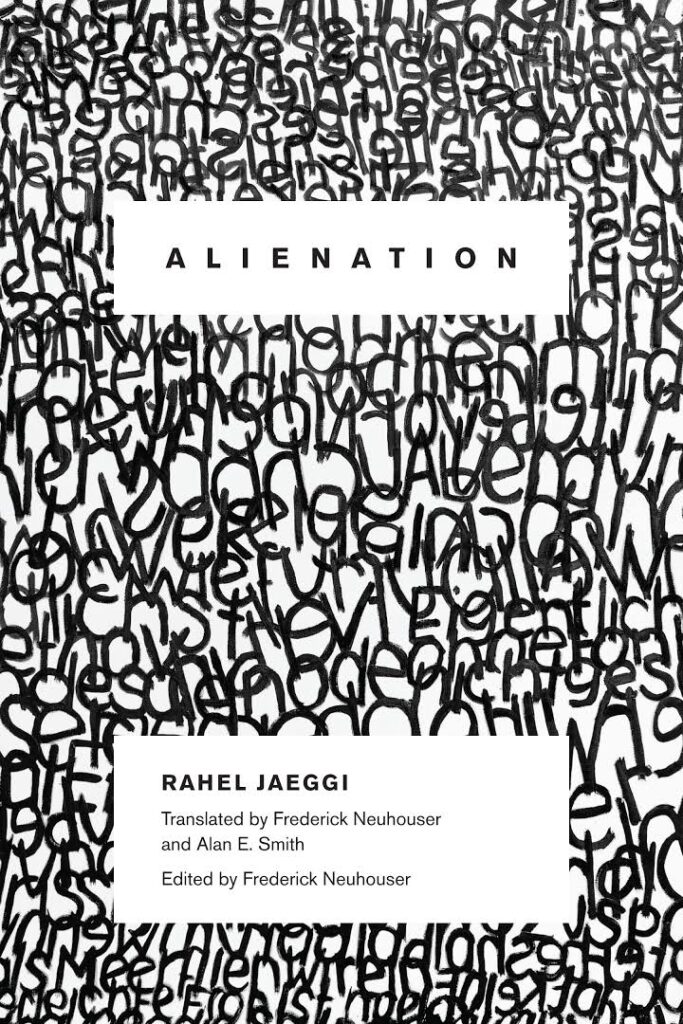
The monumental Hegel was the first who wrote about alienation as a estrangement of self-consciousness; then Feuerbach used alienation to critique religion, arguing that humans project their own ideal traits onto an abstract God. But it was Marx who grounded it in material economic production. Our inhouse philospher reviews a book published in 2014 by a Swiss professor of social philosophy at the Humboldt University of Berlin who has recovered the concept of alienation as we inhereted it from Hegel and Marx but without falling into romantic nostalgia or existentialist longing
What if I told you that you can be deeply alienated even when you do exactly what you have chosen to do and love doing?
Imagine someone who works in a profession they enjoy, who shares their life with someone they love, and fulfils their responsibilities without major conflicts, yet still feels that nothing they do ever truly belongs to them. It is not so much sadness or emotional emptiness, nor psychological distress in the strict sense, but something more fundamental: a practical distance between oneself and one’s own life, as though one’s actions continued while the connection to them had faded away.
For Jaeggi, this is the paradigmatic experience of alienation that she addresses in her book Alienation. For her, alienation consists in the impossibility of establishing a living, dynamic relationship with what one does.
Jaeggi recovers the concept without falling into romantic nostalgia, existentialist longing, or voluntaristic psychologising. For her, there is no pre-existing or natural “true self” that we must recover. What is at stake is the concrete capacity to make our own lives our own.
Alienation emerges when this process fails: when our activities, roles, or relationships are there, but remain blocked or inert—spheres in which we CANNOT intervene, reinterpret, or develop ourselves. The problem does not lie in the existence of roles; we live immersed in them: parent, citizen, teacher and so on. The problem is that we cannot make them our own, and acting within them becomes mechanical, lifeless and ultimately alien to us.
Imagine, for example, someone who carries out all their tasks meticulously at work but feels they are following a script written by others. They make no decisions, leave nothing of their own imprint, and have no room for initiative or interpretation: they simply execute. The role is there, but they are not truly present in it. It is a function without an agent.
Or think of a couple who stay together out of sheer inertia: they perform the rituals, say the appropriate words, and maintain the choreography of everyday life, yet none of the decisions that genuinely shape their shared lives reflects the agency of either partner. They live as though swept along by a current they cannot control. The relationship still exists, it is true, but it has become an empty structure in which neither partner can make the bond their own, give it direction, or imbue it with meaning. It is a relationship that continues, yes, but without any real relating.
The point is not so much that we should “put our personal stamp” on our roles as an expression of individual authenticity, but rather that the practice itself should be a space in which we can understand why we do what we do, participate in shaping it, and transform it when necessary. In Jaeggi’s terms, alienation is a relation characterised by a lack of genuine relatedness: we act, but cannot recognise ourselves in what we do; we fulfil our duties without being truly present in the task; we remain in relationships that formally continue to exist, but whose dynamics we are unable to influence or reinterpret. In short, we live without effective agency.
Although the idea of “making our own lives our own” might sound voluntaristic, Jaeggi insists that alienation does not depend solely on individual decisions, but also on the material, institutional, and cultural conditions that make such appropriation possible—or impossible. It is not enough for someone to want to take responsibility for their life: the structures must also allow that responsibility to have real efficacy.
Although this issue is not fully developed in this book, but rather in her later works, the concept of alienation carries within it the seeds of social critique in a strong sense, firmly embedded in the Frankfurt School tradition. If alienation is a pattern of failed relating, then overcoming it requires us to reconsider the forms of life and the institutions that structure our practices. The individual and the collective are not separate worlds: an individual’s capacity to act exists only when it finds a framework that sustains, enables, and expands it.
For this reason, overcoming alienation, for Jaeggi, does not mean retreating into an inner self or reinventing oneself through sheer force of will. Rather, it means transforming practices and contexts, opening up spaces in which we can reshape what we do together with others, reconfigure relationships, reinterpret roles, and create institutions that are more open to effective participation.
Overcoming alienation ultimately means recovering the possibility of seeing ourselves in our actions and exercising a concrete, situated freedom. It entails two inseparable movements: collective solidarity to transform the world we share, and individual courage to learn to inhabit it actively, within relationships in which we can act, understand, and modify our roles, and in which we can genuinely take charge of our own lives.
Hernán B. Aliaga is a writer and a social philosopher. He is a former lecturer at Pontificia Universidad Católica, Peru. He has been educated between Lima and Berlin where he now lives and is working on his doctoral thesis on social theory. He is an active commentator on social media. This is the first of a series of articles on social philosophy for Perro Negro in English. Most have already posted in Spanish in his Instagram page. You can also follow him on https://hernanbaliaga.substack.com/ and TikTok
You can access a PDF version of Alienation by Rahel Jaeggi here
Photograph of Rahel Jaeggi by Philosophie Magazin

Other Articles

Miles Davis: cien años de un titán
Un genocidio de marca





No Comment! Be the first one.