

By Professor Jason Wilson
The first of a triad of articles in which Professor Wilson explores the relationship between poetic inspiration and philosophical expectations in 20th century Latin American poetry. In this first instalment, he looks at the poet who spearheaded our Modernismo by transforming Spanish-language: the truly prothean Rubén Darío
'Qui suis-je?'
André Breton, Nadja
Lionel Trilling's essay On the Teaching of Modern Literature, written in 1961,' pursued his worry that the study of literature could not improve his students, make them better citizens and patriots; quite the opposite, modern literature is 'shockingly personal" and seduces with a dangerous, dissolving freedom, a 'surrendering oneself to experience without regard to self-interest or conventional morality, of escaping wholly from the societal bonds'.' Trilling deliberately echoed Nietzsche's defence of the Dionysiac, that self-forgetting in the 'mysterious primal Oneness' where 'the spell of individuation is broken', a path of excess reined in by the Apolline, or societal moderation. Nietzsche particularly attacked the Socratic, the 'theoretical man', the rational optimist, blinded by faith in the explicability of being. As a university teacher, Trilling was a Janus-figure, looking one way towards the anarchic thrill of creativity and the other towards Socratic policing and censoring of Dionysiac enchantment.

This is the paradox of teaching subversive literature: we are funded by society and impose on Dionysiac trances a culture of examinations and a comforting rationality. From within the safe institutional framework of the university, we constantly implement Plato's expulsion of the poets from the public arena because they arouse and confuse our minds. This analysis will explore this Nietzschean conflict in three Spanish American poets and simultaneously outline and defend the excessive way poets read other texts as they re-enact this 'ancient' quarrel between poetry and philosophy, in terms of the imperative, or social burden, of having to be responsibly 'Latin American'.

Rubén Darío (1867-1916)

My first example represents a landmark in Spanish American literature, and grapples with the function of the poet in neo-colonialist societies. One of Latin America's foremost critics, the Uruguayan José Enrique Rodó, dismissed the poetry of Rubén Darío, the Nicaraguan, who at that time -1899 - was making his name as icon in Buenos Aires, was rejected as 'not being the poet of America'. For Rodó, Darío indulged in 'the facile giddiness of a lark' ['el mareo fácil de la alondra'];  and wrote a dangerously frivolous and capricious poetry that was 'entirely irresponsible'. Rodó's metaphor for these poems was a 'wine-glass filled with lyrical foam' (a kind of mental champagne). Rodó brushed aside Darío's exploration of the thrill of creativity, the sensations that freed the mind and promised momentary paradises, in the name of social and civic responsibility. With newish nations to form in Spanish America, why gush operatically about 'sacred sperm', 'immortal females', 'hot burning kisses', etc.

Rodó was particularly irked by Darío's bad example, by the legion of imitators who swallowed the poet's bohemian message of excess (lust, booze, pleasure, idleness) and by the elevation of the poète maudit (the 'damned' poet, Edgar Allan Poe, Verlaine) into a role model." Rodó cursed the way readers read Darío uncritically as no way to become citizens of an América dominated by the United States and without clear national projects. As is obvious, Rodó's objections to Darío's readers echo what Plato put in Socrates's mouth about gullible readers. A quick summary: poetry's 'terrible power to corrupt' stirs up strong feelings that carry us away; the poet gratifies and indulges the instinctive desires' that obscure common sense and truth. Thanks to these poets 'desires control us'.

An image of this Dionysiac poetry (i.e. Rubén Darío's) comes in Plato's views on dreams where he says 'our fierce bestial nature' is awoken and 'pleasure and desires are lawless and violent'. No wonder Rodó refused to condone Darío's lawless verse, especially when admired by readers. To counter the poet's corrupting power, the philosopher Socrates (like all critics) planned to 'break the enchantment' by reading poetry critically: 'so great is the natural magic of poetry. Strip it of its poetic colouring, reduce it to plain prose, and I think you know how little it amounts to." However, to muddle things, at the heart of this deconstructive and moral task lies Socrates's confession that 'we know their fascination only too well ourselves'. In fact, just before he died, a dream urged Socrates to compose poems for the first time in his life (a hymn to the gods)." Here we have the university teacher's and critic's dilemma in a nutshell; Rodó adored Darío's daring poetry, but resented its spell on readers (like Socrates before him).
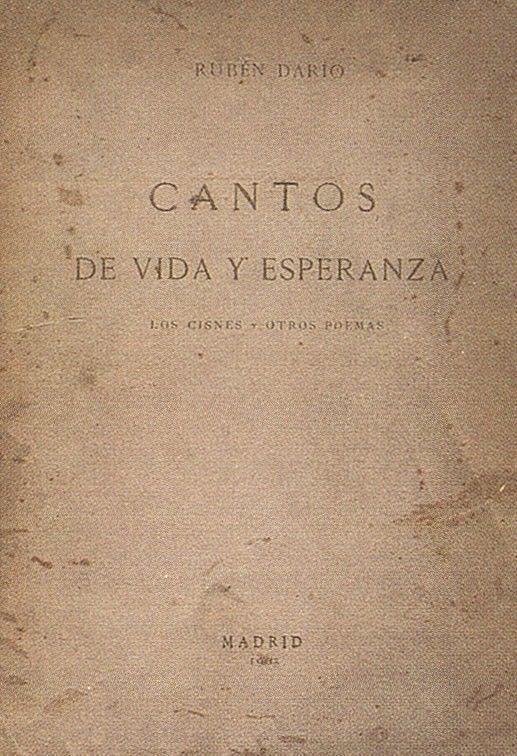
The word 'lawless', the mindless sensations induced by the trance of music, of poetry, of lust, lead to Rubén Darío who often tapped into these 'lawless' mysteries, and returned dazed as Socrates had predicted, for poets write many fine things but understand nothing of what they say'. In the wake of Rodó's public rebuke about not being socially responsible, Darío, in his Cantos de vida y esperanza (1905) tried to write sensible civic and public defending Latinity, attacking Roosevelt, celebrating the poems quatercentenary of the discovery of América, but by then he had paid the price for his lawless poesía maldita and, despite his immense social prestige in the Hispanic world, his last sad years were dogged by continuous nightmares and alcoholic depressions, finally dying of cirrhosis of the liver in 1916. In 1905 Darío published a laconic poem that touched on this ambiguous experience, and that offers a model of a special kind of reading.16 The poem opens with Salome forever dancing in the present tense in front of Herod ('En el país de las Alegorías / Salomé siempre danza'). She is not a historical figure, safe and locked up in the past, but an allegory of a taboo desire.
Frank Kermode once warned us that the figure of Salome was 'a curiously complicated subject'," explored by Mario Praz before him as a variant of the Fatal Woman.18 Here in the poem, despite John the Baptist's power (lions tremble in his presence), the axe falls and blood flows ('cae al hachazo. Sangre llueve'). Then the poem shifts from a representation of this biblical scene with a curt 'Pues' and leaps away from Salome and the severed head to offer a disturbing amalgam of meanings:

Pues la rosa sexual
al entreabrirse
conmueve todo lo que existe
con su efluvio carnal
y con su enigma espiritual.

[the sexual rose
as it half opens
affects all that exists
with its carnal effluvium and its spiritual enigma]

We know that Salome was the 'Goddess of the Decadence'; that, in Huysmans' words, she was 'the symbolic incarnation of undying lust', recreated around the globe from Oscar Wilde and Gustave Moreau in Paris to Julián del Casal in Cuba, but why this half-opening sexual rose? Unlike some of his European contemporaries, Darío showed no fear confronting a Salome who danced so erotically that Herod offered any reward she wanted, and after consulting Herodias, her mother, had asked for John the Baptist's head; for many of the decadent poets and painters this girl's whim of pleasure out some obscure revenge induced panic, the terrible mother, a naked Kali trampling men. For Darío, though, Salome was more a capricious, sensuous muse, for we have this strange visual yoking of a severed head (a bloody flower) with a sexual rose (a vulva flower), that moves the cosmos with its carnal 'effluvium', a stench and scent capturing the frightening enigma of birth and death and sexuality, and enigma etymologically means poetic riddle; so Darío shockingly personal and confrontational in terms of his reader in Lionel Trilling's sense together blood, stench, vulva, death, cosmic sympathy and lust, maybe even alluding to menstruation, but whatever, the poet asks the reader to contemplate this source of life, and poet and reader struggle with this riddle.

A clue to Darío's presentation of Salome emerges from Huysmans' novel A rebours (1884). Through the protagonist Des Esseintes, we learn that the vertigo of art must 'throw you into an unknown world', beyond time, society and country. Huysmans' example of this powerful art is the French painter Gustave Moreau's painting 'Salomé dansant'; her lascivious dance', with nipples erect, and diamonds covering her naked, sweating body 'crachant des étincelles',  transformed the chaste biblical girl into 'the symbolic deity of indestructible "Luxure" [Lewdness] ... la beauté maudite [damned Beauty]'; this metamorphosed Salome, like Medusa, poisons all who approach her with her hysteria. Huysmans linked Salome with Kali, across cultures, as avenging women, and this primal panic she induced ('la terreur de l'être humain') stirred up Huysmans' guts, made him giddy ('pris de vertige'). Darío read and absorbed Huysmans' panic about the 'bloody enigmas' by linking severed head with sexual mysteries (and carrying over Huysmans' exact words into his poem). In another incantatory poem celebrating Darío's pansexuality, 'Carne, celeste carne de la mujer' [Flesh, Celestial Woman's Flesh], illustrating what Octavio Paz called the 'great sexual wave' soaking all Darío's work, we read: 'In her flesh is the lyre / in her flesh is the rose / in her flesh is the science of harmony in her flesh we breathe the vital perfume in everything', where the 'effluvium' of the Salome poem doubles as perfume and the sexual rose is source of all art and knowledge.

The Darío poem challenges the reader: to be a poet you must interrogate Salome, goddess of birth and death. Octavio Paz, reading Darío's reading of Huysmans' reading of Moreau's reading of Flaubert's reading of the Biblical Salome, found that Darío's Salome 'embodies the deep, sacred, cosmic amorality', outside law and society. Darío's compressed Salome poem closes with 'Enigma espiritual'; and proposes an alternative identity to a social and civic one, based on a lawless experience, outside time, place and history; the poem itself dispenses with the poet's 'yo' which art's intensity has dissolved. The sexual passage to understanding half-opens and gut-understanding is mindlessly experiential (there is no self). Despite Rodó's Socratic attempt at censoring him, Darío creatively read Gustave Moreau's painting depicting a somnambulistic, bejewelled Salome so that this painting spoke through him, became him.

Nietzsche's version of the Dionysiac proposed that the poet became a work of art, that art carried out an inner transformation in the artist that was worth more than any poem. In Rodó's terms, Darío's dangerous identification-reading of Huysmans shows how, when a poet reads, there is, in Socrates's terms, a kind of moral pollution; Darío didn't read Moreau and Huysmans, he was possessed by them, thus contradicting the Socratic refusal of the trance of art. In terms of the ancient quarrel of my title, Darío sided with the Dionysiac poets, the maudits, he quipped in a poem: 'Verlaine is better than Socrates'. Salome danced so erotically that Darío willingly lost his head. Striving to be the poet of América was an irrelevancy.
Jason Wilson is an Emeritus Professor at University College, London. He has published numerous books, including Octavio Paz. A study of his Poetics (CUP, 1979, into Spanish in 1980, reprinted in 2009) and Octavio Paz (Twayne, 1986), Jorge Luis Borges (Reaktion Books and Chicago University Press, 2006, translated into Portuguese 2009, Chinese, 2011 and Turkish 2011), A Companion to Pablo Neruda. Evaluating the Poetry (Tamesis, 2008 and paperback, 2014), He has edited and translated Alexandre von Humboldt’s Personal Narrative of a Journey to the Equinoctial Regions of the New Continent (Penguin Classics, 1995), His most recent publication is Living in the Sound of the Wind. A Personal Quest for W. H. Hudson, Naturalist and Writer from the River Plate (Constable, 2015, paperback 2016, into French 2018 and into Spanish, 2023, with Ateneo). He spends his time between London and Buenos Aires. He is currently writing on how he became a hispanist.
This article first appeared as Occasional Papers No 22 of Institute of Latin American Studies, University of London, (2000)

Other Articles

Peán a mi perra… negra
Las formas del pasado I




No Comment! Be the first one.