

By Ingrid Aragüés
How often can be said that one has seen an unforgettable Shakespearean production? The honest answer: very seldom. The bard's language is often, and deliberately, too rarefied and intricate that only snobs, scholars or snob scholars can claim to truly enjoy it. Well, the small miracle of an unforgettable Hamlet has happened at The Barbican a couple of weeks ago performed by a riotous Peruvian theatre troupe
Recently I went to see Hamlet at The Barbican by Teatro La Plaza. The event description stated the play would be performed by a cast of actors with Down Syndrome and that it would be played in Spanish with English subtitles. At the beginning I didn’t know what to expect, “just another Hamlet”, really. In fact, embarrassingly enough, I was expecting three witches to show up.
Yes, I’ve seen Hamlet before, and watched films, and adaptations. I read those dusty, crumbly-paged editions written in Early Modern English while I was a student, together with so many other classics (except for El Quijote). Just probably not in such a memorable way so that I would not mix it with Macbeth, very briefly though, in my defense.
It was my first time watching a production by Teatro La Plaza, and as a Spanish person in London I was very excited about being Peruvian and a well-known troupe for exploring thought-provoking topics. Also, it would be in Spanish! At The Barbican no less! As soon as the play finished and I wiped my tears off with laughter I knew it wouldn’t be the last time watching them. I wanted more.
Written and directed by Chela de Ferrari, the play imagines Hamlet as a person with Down Syndrome, regarded “unable” to rule a kingdom due to his “flaws”. Being that the main premise, the production draws parallels between Hamlet and key moments in the life of the main character Jaime -or Jaimlet, as he’s called in the play, reflecting on themes of exclusion, ability and leadership.
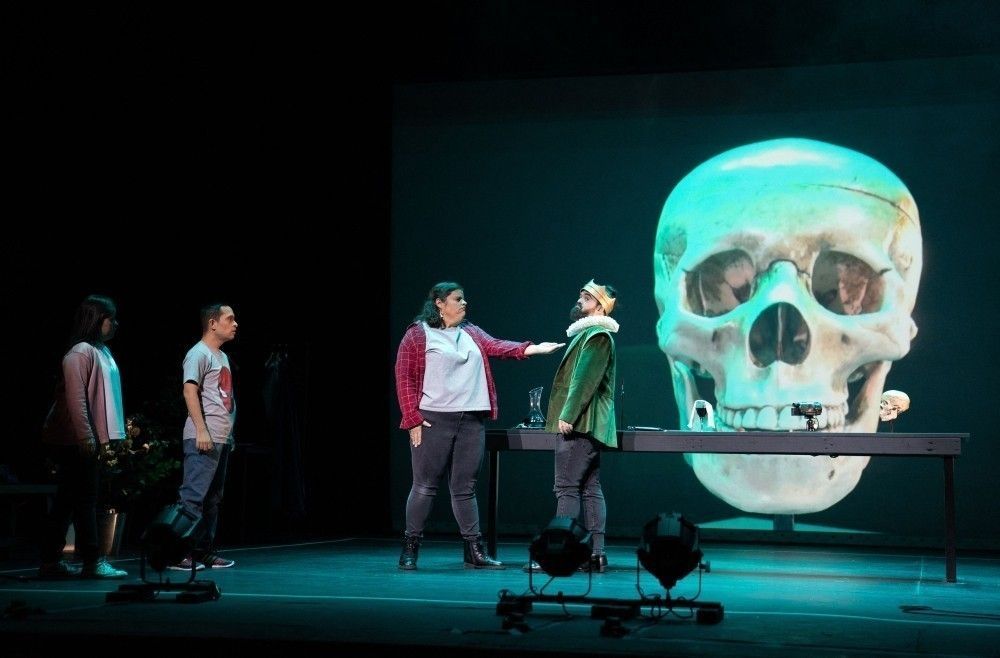
The show started with a video projection of a woman giving birth, raising the question of whether this world is worth being born into- especially as a person with Down Syndrome. Then a short pause for the whole cast introduction and, in comical way, they explained the possible “flaws” that the show could have due to their being neurodivergent. They asked the audience to be “patient” , warning that such and such might happen. They talked about their speech impediments and explained they had subtitles on screen for that reason, despite the fact that we were in England and the play was in Spanish.
Discussions on representation and decolonization have been shaping public debate for the last decade, unsettling the “anti-woke” who feel threatened about the “flawed” or the “unfit” taking more and more spaces that once belonged to “the normal”. But Jaimlet doesn’t just participate in that conversation, it turns it upside down. Ladies and gentlemen, a big round of applause for the director of the National Theatre himself, Laurence Olivier! His iconic Hamlet, farcically impersonated by a cast with Down Syndrome! Welcome, welcome!
“Jaimlet is probably the most subversive interpretation of Hamlet I’ve ever watched… containing drama, musical theatre, poetry, rock and roll and even bachata! In all honesty, try reading a Shakespearean love letter with bachata in the background. It changes the whole concept of “Shakespearean””
After laughing like never before, I couldn’t help but wonder, who are we taking as role models and why are we choosing them? Are they actually any good? How fit are they to speak to us and to our own realities? Who gets to choose who speaks to us and why do we automatically accept it without even questioning it?
The play also broke the fourth wall, calling the public onto the stage when performing Hamlet’s Mousetrap. They reflected on what neurodivergence or neuronormative is by doubting the public neuronormative abilities to interpret the scene “just like one of us”.
“We cannot ask them to do that, they would not know how to do it!” – they discussed onstage.
Love, power, revenge, death… the classic Shakespearean themes viewed from the lens of Down Syndrome. But the best thing is, I don’t need to have Down Syndrome to identify with the essential and the most universal characteristic of human species -mortality. With birth and death mirroring each other, the play also contemplated suicide as “un acto en defensa propia” or a “self-defence act” to properly “defend yourself against the world”.
The stage direction combined musical theatre with filming, played with lights and shadows, had masterful stage coordination and a remarkably talented cast at their best. A flawless mise-en-scene, in my opinion. It was consistently breaking any expectation and challenging any assumptions that I could spontaneously make. (And also challenged my attention span!)
With neurodivergent diagnoses being on the rise these days, and half of the population self- identifying as neurodivergent, how many Jaimlets regarded “unfit to rule” will it take to depose those Ambassadors of Normality, the Champions of the status quo, the Heralds of the Mundane, the “Very Fit Ones” and their ableist perspectives -or put it differently, the current ruling human landscape in the world (*coughs*). Will they stop pathologizing any form of being that’s different to the norm, then using that as an excuse to unleash their entitlement and take over spaces of power?
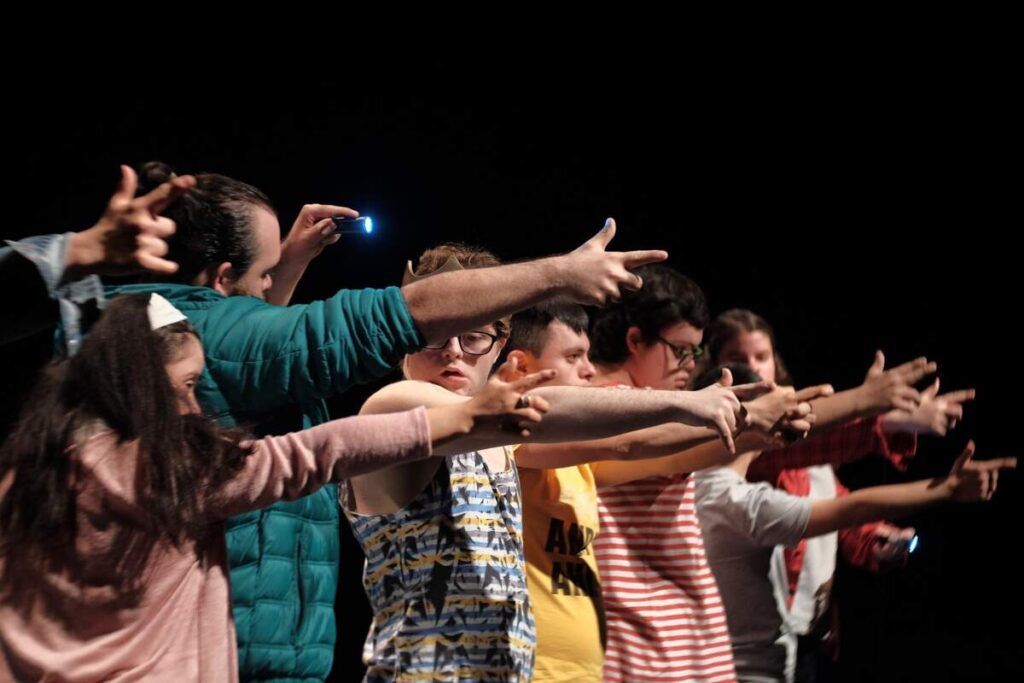
Jaimlet is probably the most subversive interpretation of Hamlet I’ve ever watched or remembered. Overall a witty comedy with a good dose of self-deprecating humour, satire and social criticism, but also containing drama, musical theatre, poetry, rock and roll and even bachata! In all honesty, try reading a Shakespearean love letter with bachata in the background. It changes the whole concept of “Shakespearean”.
It comes as no surprise that they sold out in Edinburgh. It was truly inspiring to see the way they pushed boundaries and challenged the assumptions, not just about neurodivergence but also about the neuronormative. Jaimlet is a proper statement that encourages and empowers to unapologetically take spaces that were denied in the first place. Also, not just another Hamlet, I will surely remember now where the witches belong.
Ingrid Aragüés is writer, translator and satirist. This is her fourth article for Perro Negro. She is currently working in the most personal of all her projects so far: getting ready to read Don Quixote of La Mancha.

Other Articles

Las formas del pasado I
¿Cuándo se alcalinizó de verdad Mario?


No Comment! Be the first one.