

By Alessandra Migani
It might sound profane but the Venice Biennale is not the equivalent of the Olympic Games of Art but its World Cup in terms of daring imagination. Nonetheless, it is a place where every two years the cultural wars and the global political discourse meet face to face. This is what a Rome curator plus a Venetian photographer have reported -exclusively- back to us from the biennale’s 60th edition
“Iya ni wura, Baba ni dingi”
Mother is gold, Father is a mirror
Popular saying in Yoruba land
Benin Pavilion - Arsenale, Artiglierie
Everything Precious is Fragile
Curators: Azu Nwagbogu together with Yassine Lassissi
Scenographer: Frank Houndégla.
Artists: Chloé Quenum, Moufouli Bello, Ishola Akpo and Romuald Hazoumè
In its debut as a National Pavilion at the 60th Edition of the Venice Biennale, The Republic of Benin made its mark. As I approached the Pavilion, I spotted the magnificent dome created by Romuald Hazoumè from a distance, standing majestically in the center of the space. I was captivated by the Pavilion the moment I stepped inside, instantly falling in love. There is immense power emanating from each site-specific artwork created by the four artists involved. I experienced the Pavilion with no prior knowledge of the theme and its meanings; purposely, I didn’t read any press communications. I only knew the very poetic title: “Everything Precious is Fragile”.
So I started thinking about what I consider precious, and my thoughts and heart immediately turn to our precious families, nature and planet, our precious traditions, mothers and fathers, ancestors, our precious children of the future… And yet, all of these remind me of the fragility of our existence. But what I immediately perceived in the Pavilion is that fragility has been definitely transformed into strength, with women at the center of their communities. I saw this in the artwork presented by Ishola Akpo, Ìyálóde, part of a series called Traces d’une Reine (Traces of a Queen), which beautifully blends African traditions and historical materials with modern times.
The gigantic woven tapestry, a 7x 4.5-meter jacquard fabric, presents an archival photograph depicting the Agodjiés, an all-female military regiment created by the queen Tassi Hangbé and named by Western Europeans the Amazons of Dahomey, surrounding a majestic queen. The artist skillfully placed her above King Béhanzin, creating a deliberate juxtaposition. This woman emerges from a modern time as a regal figure, embodying her own dimension, color, and dignity. She finds her place in history, inviting us to reconsider the past in the light of this tapestry that unfolds and gently glides before our eyes.
We may initially experience a feeling of displacement as the artist narrates a historical era of Benin, infusing it with new nuances. Here, the greys fade into color, marking a historical and emotional shift where the notions we’ve learned begin to lose their relevance and meanings.
Standing in front of the artwork, something shifted inside me, prompting questions to arise. Who are these women? Did they truly exist? Were the stories of African Queens and their all-women armies ever included in our history books? It reminded me of Black Panther, the movie, where the King has his all-female Royal guard, but “This is fiction!” I pondered. Here I am in Venice, over 100 years later, face to face with this amazing artwork where history falls into the present, exchanging glances and feeling the urge to pay my respects to the resilience of women. I am delighted to learn something new in such a beautiful way. Now, there is room for a new dialogue with the past, no longer constrained to a linear narrative as taught in school; instead, new windows have opened onto hidden events that reshape the grand tapestry of history.
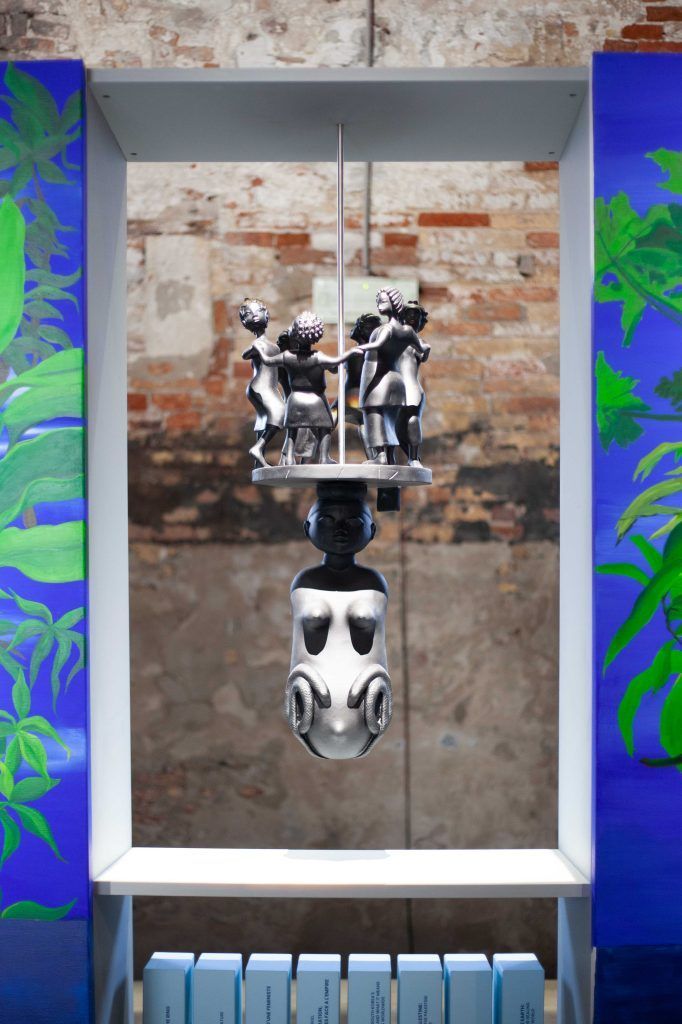
Next to this beautiful artwork, I encountered a large installation by Moufouli Bello, Egbè Modjisola, which seamlessly blends different mediums. I saw four large-format paintings (the artist’s preferred medium) arranged on a huge bookshelf filled with books, beautifully organised inside light blue boxes, alongside a Murano glass sculpture. As I perused the titles of The Library of Resistance, I noticed that they are all penned by Black feminist writers. [1]
In addition, behind the installation, there is an opportunity for a rare moment of tranquility amidst the bustling days of the Biennale opening, where visitors are invited to sit and spend some time with the books on display. In fact, they can take a book from its box, sit down, and read. In a patriarchal society where women have often been perceived as the weaker sex, with limited space to speak or intervene in matters of power, this installation symbolises a reclaiming of power. Moreover the fantastic selection of books brings together the “thoughts of women”, feminist writers who utilise words as a tool to illuminate their role in society.
I felt also deeply drawn to the paintings as I sensed a profound dignity emanating from the portrayed female figures. These portraits depict groups of women, typically three or four, gathered closely together in what appears to be a living room setting. They are elegantly dressed, with some seated on a sofa while others stand, with exotic plants serving as a backdrop. The canvases are quite large, almost life-sized, and each woman is depicted with remarkable detail. Indigo blue is a prominent feature in each painting, serving as the artist’s signature mark.
There’s a regal aura to these portraits, with the women exuding a sense of sisterhood, power and significant self-awareness. I find them almost spiritual. The indigo color the artist uses (a beautiful hue between blue and violet) reminds me of the color associated with the sixth Chakra, Ajna (the third eye), which is linked to intuition and spiritual knowledge. I then discover that the artist has Yoruba origins, and indigo is also a spiritual color for them.
Tracing back the Yoruba culture and traditions spread across Benin, Nigeria, and Togo, we encounter an important ceremony and philosophy known as Gelede, performed by the Yoruba-Nago community. In this masquerade ceremony, the primordial mother Iyà Nlà is central, celebrated through dances and chants. During this ceremony, the wisdom of the mother and the vital role of women are recognised within the community.
Moufouli Bello wrote on her Instagram page: “For me, what is both fragile and precious are women’s rights. I propose communities of women as a solution to this fragility, inspired by this cult”. I spent some time contemplating these women, and suddenly I felt in profound connection with them. I shared a glance, a gesture, a quiet moment in suspended time. The dialogue requires no translation; we are all instantly connected. Then I felt compelled to continue exploring the pavilion, it was time to enter the dome. This imposing structure demanded attention.
I always admired Romuald Hazoumè’s work, and I must say, this installation is incredibly captivating. Titled Ashé, it appears from the outside to be a semi-spherical hut, but it’s only inside that the artist’s world is revealed, with 520 petrol tank masks facing the visitors. The dome holds inside an entire world filled with countless stories, in fact those masks, crafted from repurposed tanks, are revealing economic, social, and political contexts. [2]
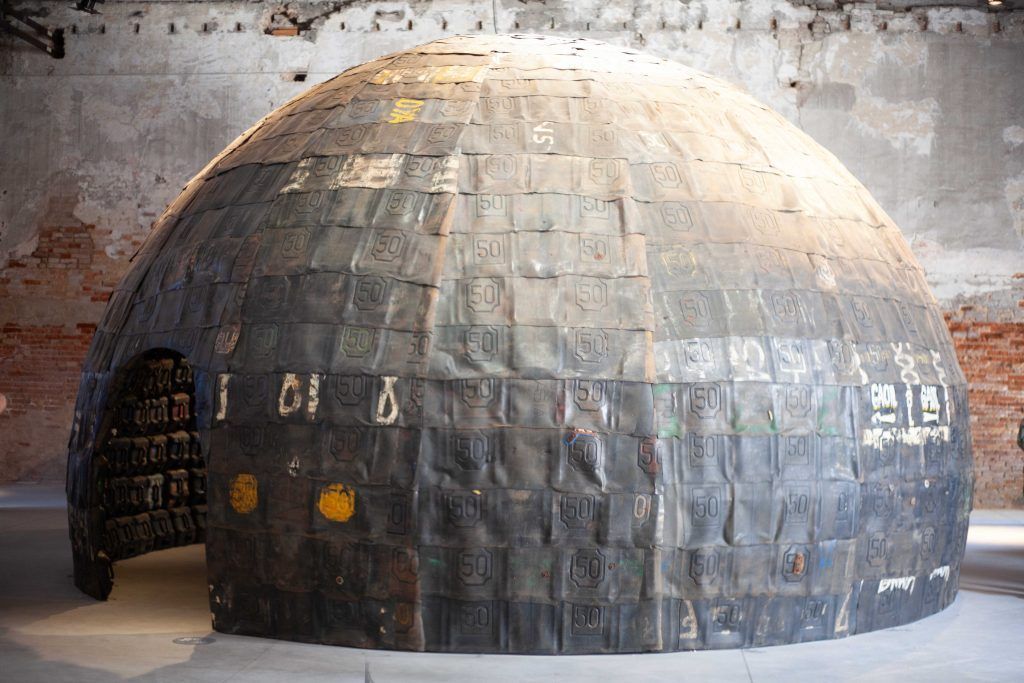
Hazoumé, who was raised Catholic but has Yoruba lineage, draws inspiration from ancestral African traditions such as voodoo spiritual practices to craft his signature masks and they are also influenced by Gelede. So he also emphasises the significance of women’s leadership in Beninese culture.
When I reached the center of the dome, I began spinning around until the masks, I felt, were eager to share their stories and memories with me. The artist infused life into them. This is the space where people gather together sharing protection and solace. The structure recalls a sacred cathedral or even a divine feminine womb, symbolising the creation of life. As we look up, we notice twinkling lights echoing the sky full of stars.
Once more, I realise the interconnectedness of everything. .
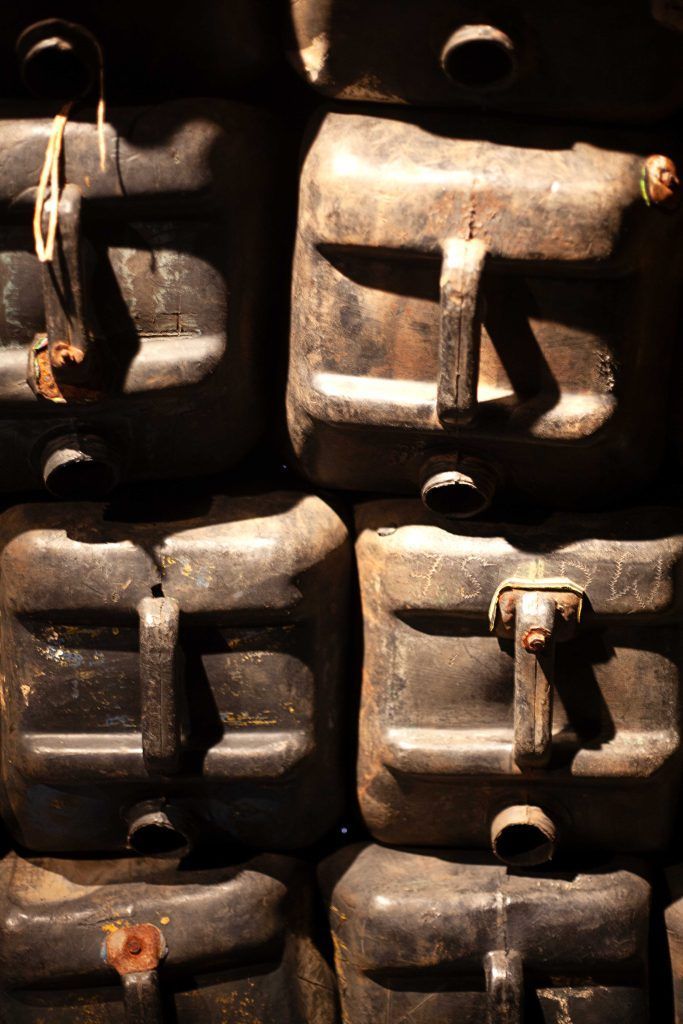
Hazoumè began crafting masks from discarded plastic containers and gasoline canisters in the mid-1980s. Petrol tanks were a lucrative business for Westerners, with people from Nigeria selling them to those in Benin. The artist noticed that his country was becoming inundated with this waste. He found a way to turn them into art by skillfully recognising faces in the shape of each one, like a pareidolian. Regarding his work, he stated: “I return to the West what is rightfully theirs — the refuse of consumer society that inundates us daily”.
After leaving the dome, I approached the installation of the fourth artist, completing the Pavilion project. A large window hung from the ceiling, mirroring the shape and size of the Artiglierie window. Behind it, there is collection of glass objects different in size and shape — pure white glass pieces that initially resembled ice, seeming as though they could melt before my eyes. It was only later that I learned this installation is titled Heure Bleue by Chloé Quenum.
In Heure Bleue everything feels displaced. The window suspended from the ceiling lacks surrounding walls, allowing us to move freely around it. In fact, what it is originally intended to offer a glimpse of the outside world from within a space, it now serves to create multiple perspectives. As we gaze upon the suspended glass objects, questions arise about their symbolic significance; they resemble musical instruments or ceremonial objects. In fact they are probably inspired by those used by different native groups during important ceremonies taking place in the Dahomey’s kingdom, linking the installation to the sounds and chants associated with the Amazon parades. The instruments are also evoking the royal artifacts looted by the French soldiers in the 1890s and recently returned to Benin from the Musée du Quai Branly in Paris.
Natural light blends with artificial light, as sunlight filters through the real window while artificial light shines through the suspended one. This interplay of light and shadow on glass objects evokes the historical significance of Murano glass beads, which were once traded as commodities throughout the Atlantic trade era. This historical context adds depth to the installation, shedding light on Venice’s uncomfortable past and its role in the history of slavery. It’s noteworthy that the ships of colonialism were actually built in the Arsenale spaces. The installation also evokes the concept of the “Blue hour”, that fleeting moment just before sunrise or after sunset when the sun dips below the horizon. During this enchanting interval, a serene blue light envelops the sky, imbuing the surroundings with a sense of peace and tranquility.
After concluding my visit to the Pavilion, I paused to reflect on the almost magical synergy among the showcased artists. I feel that they have perfectly captured the essence of the theme chosen by the curatorial team. Through this immersive experience, we are invited to reflect on the intricate web of connections that shape our understanding of the past and present. I’d like to quote Curator Azu Nwagbogu here: “During my conclusive research journey across Benin, I engaged with the custodians of Gelede culture. Surprisingly, the etymology of Gelede resonates poetically as Everything Precious is Fragile, expressed as Gue-ele-de in Yoruba. This revelation resonated deeply with me, and in that transformative moment, I recognised that we had discovered the essence of our exhibition!”.
A feeling of displacement may characterise the atmosphere within the pavilion, but it aligns perfectly with the theme selected by Adriano Pedrosa for this Biennale: Foreigners Everywhere. I ponder whether this sense of displacement is precisely what we need to perceive things from fresh perspectives. This movement of people and objects tells stories — often forgotten or hidden — yet it offers an opportunity to reshape history, shedding light on the sense of community and the bond between women and the Earth and its people. The Earth is a mother, the Earth is feminine. Here, we undergo a transformation, evolving into pure observers and custodians on Earth, no matter where we are from as in the end we are all foreigners gazing at the stars from our cathedrals.
§
Ishola Akpo: Born in 1983 in Yopougon (Ivory Coast), Ishola is a Beninese photographer and multimedia artist who lives and works in Cotonou (Benin). His work delineates, defines, and merges together – through the skilled use of various materials – the boundary between reality and fiction, past and present, tradition and modernity, with the female figure always at the center, often depicted as a regal figure, a queen.
Moufouli Bello: Moufouli Bello is a multi-media artist from the Republic of Benin, trained as a lawyer with a master’s degree in International Labor Law. Bello’s ongoing interest in issues surrounding identity informs a significant amount of her work. She places considerable emphasis on the impact of traditions, culture, politics and most recently technology on our perception of the self and society, our emotions and human behavior. Her portraits focus on the representation of black woman and their visibility, often with intimate subjects directly confronting the viewers gaze. Bello’s professional artistic practice officially began in 2012 in Cotonou, Benin and she has since participated in international exhibitions including in Paris, Lomé, Casablanca and Vienna.
Romuald Hazoumè: A contemporary artist born in Porto-Novo, Benin, in 1962. He is best known for his sculptural installations that explore themes of identity, globalization, and consumerism. Hazoumè often incorporates found objects and recycled materials into his work, such as plastic jerry cans, discarded gasoline canisters, and other everyday items. Through his art, he addresses social and political issues facing West Africa, including the legacy of colonialism, environmental degradation, and economic inequality.
Hazoumè’s work has been exhibited widely internationally, including at prestigious venues such as the British Museum in London, the Venice Biennale, and the Metropolitan Museum of Art in New York City. He is considered one of the leading contemporary artists from Africa and has received numerous awards and honors for his contributions to the art world.
Chloé Quenum: she received her diploma from the École nationale supérieure des Beaux-Arts de Paris in 2011, with the congratulations of the jury, and pursued her education at the Ehess in 2016, where she studied the anthropology of writing. Chloé Quenum’s early installations were characterized by the play of displacement and the staging of ordinary objects. Today, her work is based around an anthropological and historical approach, focusing on different regions around the world, particularly West Africa and Oceania. She makes use of multiple materials, borrowing forms and graphic signs, and transposing them onto new supports, through the use of artisanal techniques and procedures. Through and in her work, we witness the fusion of cultures, histories and references, allowing us to question the interpretation and context surrounding the reading of an object.
[1] The Kingdom of Dahomey 1600-1904 (located where Benin is today) was a prominent player in the slave trade, particularly in collaboration with the Oyo Empire, a Yoruba kingdom in West Africa.
[2] Ashés are the women who hold the power in the Gelede cult.
Alessadra Migani read Literature at La Sapienza University in Rome. Her graduation thesis was a research on the history of music videos and their intersections with cinema. She has collaborated in festivals such as Enzimi, Rome, and Onedotzero, London. In 2011 she directed the art gallery Contemporanea in Rome. Her curatorial work includes researches on expression of African diasporic identity through photography, video art, and site-specific installations. She writes about art for various online magazines and this is her first piece for Perro Negro. She lives in the Italian capital.
Fotos by Fabio Lattanzi Antinori. He is a visual artist working across disciplines: sculpture, image and data. He lives in London @flantironi
Venice Biennial 2024
60TH INTERNATIONAL ART EXHIBITION runs until 24.11.2024
More info : https://www.labiennale.org/en/art/2024

Other Articles

La sexagésima Bienal de Venecia
Nace un secreto
No Comment! Be the first one.