

Professor Jason Wilson
“Every poet is a cannibal, every artist is a thief. All kill their inspiration and sing about their grief” These lines by Bono of U2 are applicable to what Jason Wilson says about Neruda poetic inspiration. Second part of a final instalment of these wonderfully written essays that have covered three major literary figures of Latin America: Darío, Borges and Neruda
Neruda’s long, 1934 love-lament Furies and Heartache refers, as I’ve hinted, to Josie as a dog of fury and to his own penas de amor [heartache]; the poem’s title, as the epigraph reveals, evokes a sonnet by the Spanish Golden-Age poet Francisco de Quevedo (1580–1645). Quevedo’s mocking sonnet has a long title, which if we read as Neruda’s own becomes a bizarre confession. The sonnet’s title: ‘He pretends in himself to suffer a hell, whose heartache he tries to mitigate, like Orpheus, with the music of his song, but without managing to do it’. This ironic title suggests the question: did Neruda pretend passion or is his poetry the failure to quench it? In Quevedo’s case, given church censorship, you could argue that he pretends to pretend, and is sincere by lying. In Neruda’s case sincerity underscores his romantic poetics, so this Quevedo sonnet consciously confesses his duplicity. What Quevedo / Neruda assert is that art is no compensation for the kind of love Josie offered him. Quevedo / Neruda see themselves as threatened by the ‘burning flame’ of love, so they pretend to be Orpheus (‘pruebo a ser Orfeo’) but cannot really become Orpheus as trapped in their heart are ‘furies and heartaches’; love remains an inner tyrant. The sonnet ends:
Y yo padezco en mí la culpa mía,
oh dueño sin piedad, que tal ordenas!
Pues del castigo de enemiga mano
no es preciso, ni rescate l’armonía
[And I suffer in myself my own guilt,
oh pitiless master, who has ordered this.
For with this punishment from an enemy’s hand,
harmony is impossible, cannot rescue me.]
We can now read, through Neruda / Quevedo, that he accepts the blame, that even if he were a poet like Orpheus he could never compensate his abandonment of Josie – Eurydice, for writing verse is no ‘rescate’.
Now we can explore the paradoxes of trying to abandon an inner enemy-muse. Josie embodied an asocial, inner knowledge imparted by Dionysus, as freedom from rules and law and bourgeois life that Neruda wanted but couldn’t actually handle. The poem ‘Furies and Heartache’ narrates this infernal journey into her inner depths, into a ‘cañaveral’ (reedbed), with tigers and dangers where the lovers ‘con la boca olfateando sudor y venas verdes / nos encontramos en la húmeda sombra que deja caer besos’ [‘with our mouths scenting sweat and green veins / we meet in the damp shade that kisses let fall’]. Neruda insinuates this vertiginous inner experience through metaphor and image, the dissolving zone explored by George Bataille. Josie Bliss is the ‘enemiga de grandes caderas que mi pelo han tocado / con un ronco rocío, con una lengua de agua. [‘enemy with great hips that touched my hair / with guttural dew, with a tongue of water’], who granted Neruda rebirth into an asocial, alternative self, baptised with the waters of his lover, in a new bodily configuration. She helps him pass through a wall to find himself at ‘the centre of some sweet limbs’ where he (and she) can ‘y muerde cada hoja de un bosque dando gritos’ [‘bite every leaf of the forest, letting out screams’]; the same convulsive love that André Breton evoked in his narrative of male cowardice, his abandoning of his Melusine, or Nadja, written in 1928. Gut-knowledge of self is tested and proved as intense sensations, as intense metaphors; biting every leaf in the forest, screaming. Josie taught the poet ‘divination’ (‘adivinas los cuerpos’ is repeated twice), a new way of being, through her legs ‘las piernas que te guían’ [‘that guide you’]; for she, guided by her body, initiated Neruda into the sexual enigma.
In this 1934 poem, Neruda’s evocation of Josie’s ritual skills is extraordinary; she throws off her clothes, her keys, her coins, and is naked; she rolls on the floor where ‘el viejo olor del semen como una enredadera / de cenicienta harina se desliza a tu boca’ [‘the old smell of semen like a creeper / of ash-like flour glides to your mouth’]. The poet touched raw life that ‘throbs from the sweet navel to the roses’; mindless brute life:
nada sino esa pulpa de los seres,
nada sino esa copa de raíces
[nothing but this pulp of beings,
nothing but that crown of roots.]
Neruda characterised this poetic wisdom as:
… una sorda ciencia con cabello y cavernas
y machacando puntas de médula y dulzura
he rodado a las grandes coronas genitales
[… a dumb science of hair and caverns
and pounding piths and sweetnesses,
I rolled into great genital wreaths.]
This extraordinary liberational poem of 1934 echoed the poem Nuptial Material of the same year, which also posits knowledge through her superseding knowledge, there was no I and you … a new, paradisal unit’; and again: ‘she was such bliss of release, that he would have suffered a whole eternity of torture rather than forego one second of this pang of unsurpassable bliss’. Bliss as shattering knowledge, Nietzsche’s Dionysiac intoxication, a surrender of self through ‘extravagant lack of sexual discipline’, had a crucial spin-off, for we are dealing with a poet’s way of writing new kinds of poems where Neruda could ‘relate directly, with a kind of virility and scorn for formal concerns’ that liberated him from his Hispanic worries about the primacy of poetic form, where craft and formal skills override real meaning. In the poem Agua sexual [‘Sexual Water’] Neruda defined this vertiginous vision of the poet breaking societal and linguistic taboos as his conscious poet’s task: ‘como un párpado atrozmente levantado a la fuerza / estoy mirando’ [‘like an eyelid atrociously, forcibly lifted / I am watching’]; this watching has pierced into an unexplored zone beyond ethics and aesthetics.
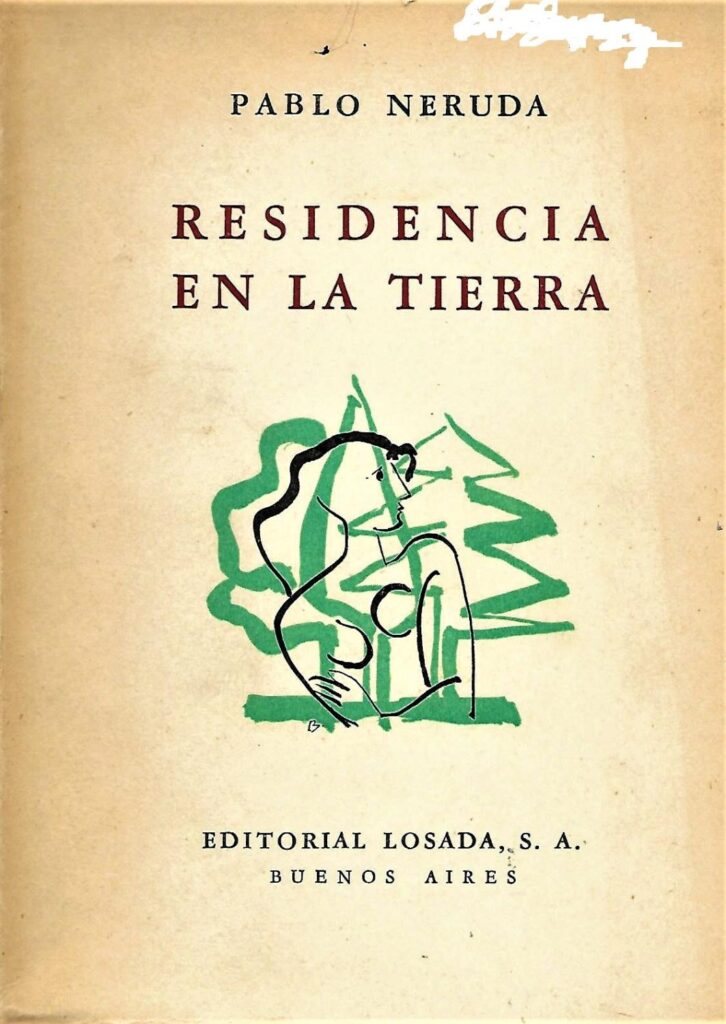
Neruda abandoned Josie in another way by publicly denouncing his collection of Josie-Bliss-obsessed poems, Residencia en la tierra I & II (1935), that closes and culminates with the poem ‘Josie Bliss’. He had discovered, through his cowardice, that he was not a lawless poet, for, as he noted later in his memoirs, ‘we poets have the right to be contented’ and contentment meant moderation, marriage, obeying civic and patriotic rules, the Appoline, accepting becoming the Poet of América. He rejected what he deceitfully called the dense pessimism of the collection when he heard that a young Chilean had killed himself with a copy open on a poem, but the poems are not pessimistic, simply grieving. Neruda told an interviewer that he was tempted to ‘forbid the reading of that book’ and ‘arrange never to have it printed again’. Neruda also refused permission for these Residencia poems to be translated in the Communist bloc, so violently did he try to exorcise Josie Bliss’s knowledge; and he never recorded them. He once characterised his Residencia poems as a ‘tormented dictionary of my personal investigations’, and wrote to the Spanish poet Rafael Alberti in the 1930s that ‘I do not understand anything about politics, I’m an anarchist and want to do what pleases me’. But by 1954, a paid-up member of the Chilean Communist Party, he could assure his readers that a poet ‘should be deliberately national, reflexively national, maturely patriotic’. Over the 1930s and 1940s Neruda slowly returned to the fold, albeit a republican and Marxist one, but acceptably didactic in Socrates’s ideal state, identifiably a poet of América. The official Neruda story has it that the Spanish Civil War had changed Neruda’s poetics as it did that of so many other poets, but I have insinuated that it was Josie Bliss who forced Neruda to flee from the dangerous knowledge that she offered him; his writing a vain exorcism. A biographer, without mentioning Salome or Kali or Josie Bliss, reckoned that ‘a deep sexual horror and fascination’ crosses Neruda’s Residencia poems. I would like to frame that perception with this last choice that Josie Bliss provoked Neruda to make.
In a short prose poem already cited, The Young Monarch, Neruda described his affair with Josie alone in their ‘amorous territory’ as a ‘patria limitada por dos largos brazos cálidos, de larga pasión paralela’ [‘homeland limited by two long, warm arms, by a long parallel passion’]; implying that his love affair had created an alternative ‘patria’ bounded by mutual physical passion, his identity no longer that of a Chilean poet in exile in Rangoon, but that of a lover with a real woman who taught him elemental freedom from all social taboos, but he fled Josie to reassert the older ‘patria’ that is Chile, accepting the muse of ‘American’ patriotism, and reams of responsible, didactic, civic poetry. In Rangoon, through Josie, Neruda chose not to be the poète maudit, not to be excluded from the republic; he wanted to belong and be its official poet.
“Three Spanish-American errant poets replay the ancient quarrel between the insights gained from poetic intoxication and philosophic knowledge, between the Dionysiac and the Appolline, between breaking taboos and searching for freedom, within the continuing Socratic debate about civic responsibilities. Darío accepted the challenge of Salome’s dance as omen about some obscure bedrock of life; young Borges thought he might be able to hold all the extremes of reality and himself together in the freedom of street life, but was routed by his own disgust; and Neruda experienced this turbulent inner freedom, but wilfully and self-torturingly rejoined the tribe.”
As a traveller in the Far East and far from home, but without a wife waiting and weaving, I can read Neruda as the wandering Ulysses (Neruda had read Joyce’s Ulysses) who in book ten of Homer’s The Odyssey reaches Circe’s island; with a little help from Hermes, Ulysses avoided being turned into a tame animal and lived as Circe’s lover for a year until he yearned to return home, to his patria. Now, Circe’s drug, according to Homer, made men lose all memory of their native land; Hermes had warned Ulysses that he would ‘never see your home again’. This incident illustrates Neruda’s rejection of Circe’s, or Josie’s, love, for such love offered an alternative home, deeper roots, a private, asocial space living in the present tense of sensations, without future civic projects. Challenged by Josie Bliss, Neruda opted for a less ecstatic version of home; rather than Josie he wanted a socially acceptable and public position, and so left Circe-Josie. By rejecting Josie, enemy of his peace of mind, Neruda endorsed the conventional male-view of Circe, in Eliphas Lévi’s words: ‘Circe is the vicious female who bewitches and debases her lovers, who inspires nothing but brutal passions; they exhaust and disdain you … They are beautiful, heartless monsters …’.
I can read Neruda’s secret story into one last wandering literary hero’s plight to make his inner decision to reject Salome/Circe/Josie quite clear, and to insinuate Josie’s inner response to Neruda’s cowardice. In Virgil’s Aeneid, Queen Dido of Carthage, a widow, succumbs to Aeneas and hopes to live with him, but the gods oblige him to leave her bed and found Rome. She catches him trying to escape. He, ‘duty-bound’, like Neruda, stands mute ‘held fast his eyes, / And fought down the emotion in his heart’, but still left her. Queen Dido cursed Aeneas, now her ‘enemy’: ‘I shall be everywhere / A shade to haunt you! You will pay for this, unconscionable!’, but she refused to follow him ‘like a slave’, and having lost her integrity, ‘in bitter mourning’, killed herself. Queen Dido was the one woman who stirred him to ‘simple human emotion’. How tempting to read Josie Bliss into Queen Dido’s fate, for the silent, excluded Burmese Josie Bliss never left Neruda alone, and their agon endured in his tantalic memory. The penultimate poem of Neruda’s Residencia collection is titled ‘No hay olvido (Sonata)’ [There’s no Forgetting (Sonata)]; no river of Lethe to release Neruda’s ‘acongojado corazón’ [‘grieving heart’] from memories of Josie Bliss. Social duty, becoming a public poet, beckoned Neruda / Aeneas, their grief imprisoned deep inside.
Three Spanish-American errant poets replay the ancient quarrel between the insights gained from poetic intoxication and philosophic knowledge, between the Dionysiac and the Appolline, between breaking taboos and searching for freedom, within the continuing Socratic debate about civic responsibilities. Darío accepted the challenge of Salome’s dance as omen about some obscure bedrock of life; young Borges thought he might be able to hold all the extremes of reality and himself together in the freedom of street life, but was routed by his own disgust; and Neruda experienced this turbulent inner freedom, but wilfully and self-torturingly rejoined the tribe. The ancient quarrel, then, surfaces as the collision inside poems between safe, codifiable knowledge and a deeper, murkier experience that cannot be contained in literary studies, for the study of poetry leads each reader to this same experiential ambivalence between the risk of gut-truths and the reading of reasonable and explainable poems. Neruda, with Josie Bliss as enemy-muse, for the brief period of his great Residencia poems, was trapped in dual knowledge. Trilling, at odds with today’s academic consensus by suggesting direct contact with confusing and crucial texts, insisted that literature teachers (and readers) had to put freedom and gut-understanding ‘in the conscious forefront of [their] thought’, and nobody escapes that exposure even if we usually opt for safety.
Jason Wilson is an Emeritus Professor at University College, London. He has published numerous books, including Octavio Paz. A study of his Poetics (CUP, 1979, into Spanish in 1980, reprinted in 2009) and Octavio Paz (Twayne, 1986), Jorge Luis Borges (Reaktion Books and Chicago University Press, 2006, translated into Portuguese 2009, Chinese, 2011 and Turkish 2011), A Companion to Pablo Neruda. Evaluating the Poetry (Tamesis, 2008 and paperback, 2014), He has edited and translated Alexandre von Humboldt’s Personal Narrative of a Journey to the Equinoctial Regions of the New Continent (Penguin Classics, 1995), His most recent publication is Living in the Sound of the Wind. A Personal Quest for W. H. Hudson, Naturalist and Writer from the River Plate (Constable, 2015, paperback 2016, into French 2018 and into Spanish, 2023, with Ateneo). He spends his time between London and Buenos Aires. He is currently writing on how he became a hispanist.
This article first appeared as Occasional Papers No 22 of Institute of Latin American Studies, University of London, (2000)

Other Articles

Gustavo Cerati: filantropía y fe
Agnes La ibicenca





No Comment! Be the first one.