

By Professor Jason Wilson
The second of a triad of articles in which Professor Wilson explores the relationship between poetic inspiration and philosophical expectations in 20th century Latin American poetry. In this second instalment, he looks at the possible reason why one of the most ubiquitous writers of the last century stopped writing poetry for thirty one years
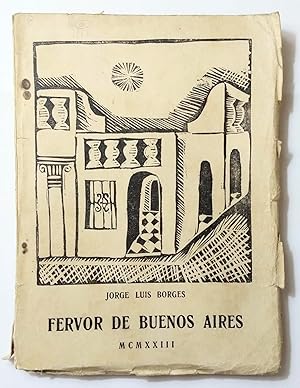
My second, briefer, example is Jorge Luis Borges; the echo of Rodó’s 1899 public taunt that Dario was not the poet of América still rang in Borges’s ears when he returned to his native city, Buenos Aires, in 1921 as a young 22 years-old poet, after seven years in Europe, like a prodigal son to an unimaginable, mutating city, bursting at the seams with massive immigration and fabulous wealth. Borges envisioned his poetic duty (as a close reader of Walt Whitman) as being to sing of himself and his American city. His first collection of poems Fervor de Buenos Aires (1923), expounds his patriotic passion. Borges, all eyes and tingling with curiosity, walk his city as a flâneur, absorbing what was new to him, what was at odds with European cities and (typically for an Argentine) dismissing the Europeanising mimicry of his very urban city and instead mythifying the empty backstreets, the suburbs and barrios, the patios and doorways, the railway sidings, the sunsets, the local thugs; and all this in the poetic guise of a recently acquired and quickly discarded avant-garde mode.
After a brief return to Europe, Borges wrote two further books of poems celebrating his city and then he suffered a poet’s block that lasted 31 years; instead he turned to prose and made his name with his stunning ‘fictions’ in the 1940s. Only when blind did he return to publishing poetry, his first love, with El hacedor in 1960. His last collection of the 1920s, Cuaderno de San Martín (1929), closed with his farewell poem to poetry titled El paseo de Julio, a reference to a street today renamed Calle Reconquista. It was the red light district, the brothel quarter of a city for its white slave trade when even Evelyn Waugh’s Lady Metroland earned her fortune from getting girls for her brothels in Buenos Aires.
Borges describes this street as one of ‘prostitution concealed by what is most different: music’, a strange line pitting prostitution against music; perhaps tango, the brothel music danced by men waiting for the girls. Music becomes corrupted by the sexual market; art cannot remain pure. Borges boasts of his ‘stunning ignorance’ of this street and cannot imagine it as part of his country; ‘nunca te sentí patria‘. A double failure lurks behind this line; the first is sexual, the enigma of Borges’s sexuality which has biographers in a tizz; the second is that he was not the Latin Walt Whitman, facing every aspect of his city. The poem piles up references to this street to be a nightmare, a distorted mirror, pure ugliness, his ruin, chaos, hell. In another strange in a Borges writes: ‘and the mermaid promised by advertisement is dead, made of wax’. Life for the 30-year-old Borges promised not mermaids but wax-like whores calling him to the hell of loveless sex.
Sirens (‘sirenas’) lure him to ask: ‘What god, what idol, what veneration is yours, Paseo de Julio? The last lines of the poem gives Borges his answer: your idol is death, and once Borges knows this sordid truth he ends this version of the poem with ‘just by existing, all happiness is hostile to you’ [the street]. What to make of this cryptic swan-song?
The sex without love, brothel sex, is hellish; that love without sex (mermaids) cannot exist; that Borges often fell in love but always avoided sex, and more crucially, that a poet that is unable to face up to “hell”, the experience of a loveless but sexually-driven urban world , cannot call himself a poet. We can forget Borges’s sex life but cannot ignore his flinching away from ‘reality’ and nor did he. He stopped writing poems. Later Borges would make ‘cowardice’ one of his main self-accusations in stories an verse. In terms of his patriotic songs of América, Borges could not hold in his mind both the hellish and the heavenly city of Buenos Aires; he could not longer map América.
The ties between meat, flesh, whores, tango, death and sex that this poem knots together to form an obscure biographic constellation echo and earlier poem from Fervor de Buenos Aires, tellingly titled Carnicería (meaning both butcher’s shop and carnage). This poem opens with a surprising comparison; ‘Más vil que un lunapar‘, more vile than a brothel. In curious ways both meat and whores stood for Buenos Aires; in Spanish carne means meat and flesh. For Borges the butcher’s shop and the brothel are identical, displaying cold, dead flesh; and now not an erotic Salome, but the severed head lurks in this butcher’s window that is ‘an insult’ [una afrenta] to the street, to civic wellbeing. In this window Borges describes a blind cow’s head as apart of an aquelarre, an obscure basque word for witches’ sabbath, that is, window-meat is given feminine, orgiastic associations (i.e. a brothel) that disgusts Borges. The clue to Borges’s disgust is the bizarre word aquelarre that repeats the title of a Goya’s painting showing witches offering emaciated babies to a goat-headed god. In his poem the meat is called carne charra, in bad taste, lying on a marble, a tombstone bed; the short poems ends by comparing the dead head to ‘the remote majestic of an idol’, Borges hints that he had read Goya’s depiction of the goat-headed devil Dionysus. The remote idol presiding lewdly in this butcher’s is this god of sexual excess. Perhaps the dead animal-head conjures old pagan Salome’s decapitation trophy, for she, ‘luxure’, presides over brothels and will chop off his head, ‘carnage’. Venting his personal and civic disgust, Borges sided with Rodó and Socrates; his poet’s block a gesture to save himself and his readers from corruption.
Jason Wilson is an Emeritus Professor at University College, London. He has published numerous books, including Octavio Paz. A study of his Poetics (CUP, 1979, into Spanish in 1980, reprinted in 2009) and Octavio Paz (Twayne, 1986), Jorge Luis Borges (Reaktion Books and Chicago University Press, 2006, translated into Portuguese 2009, Chinese, 2011 and Turkish 2011), A Companion to Pablo Neruda. Evaluating the Poetry (Tamesis, 2008 and paperback, 2014), He has edited and translated Alexandre von Humboldt’s Personal Narrative of a Journey to the Equinoctial Regions of the New Continent (Penguin Classics, 1995), His most recent publication is Living in the Sound of the Wind. A Personal Quest for W. H. Hudson, Naturalist and Writer from the River Plate (Constable, 2015, paperback 2016, into French 2018 and into Spanish, 2023, with Ateneo). He spends his time between London and Buenos Aires. He is currently writing on how he became a hispanist.
This article first appeared as Occasional Papers No 22 of Institute of Latin American Studies, University of London, (2000)

Other Articles
The Synesthesia of Art
Un linyera de la literatura



No Comment! Be the first one.