

Neil Postman was an American educator whose depiction of the role that mass media and the culture of entertainment play in our lives and political consciousness possesses much more directness and immediacy than its brilliant but often obfuscating French predecessor: La Société du spectacle
Huxley’s fears versus Orwell’s fears or Brave New World versus Big Brother
“We were keeping our eye on 1984. When the year came and the prophecy didn’t, thoughtful Americans sang softly in praise of themselves. The roots of liberal democracy had held. Wherever else the terror had happened, we, at least, had not been visited by Orwellian nightmares.
But we had forgotten that alongside Orwell’s dark vision, there was another – slightly older, slightly less well known, equally chilling: Aldous Huxley’s Brave New World. Contrary to common belief even among the educated, Huxley and Orwell did not prophesy the same thing. Orwell warns that we will be overcome by an externally imposed oppression. But in Huxley’s vision, no Big Brother is required to deprive people of their autonomy, maturity and history. As he saw it, people will come to love their oppression, to adore the technologies that undo their capacities to think.
What Orwell feared were those who would ban books. What Huxley feared was that there would be no reason to ban a book, for there would be no one who wanted to read one. Orwell feared those who would deprive us of information. Huxley feared those who would give us so much that we would be reduced to passivity and egoism. Orwell feared that the truth would be concealed from us. Huxley feared the truth would be drowned in a sea of irrelevance. Orwell feared we would become a captive culture. Huxley feared we would become a trivial culture, preoccupied with some equivalent of the feelies, the orgy porgy, and the centrifugal bumblepuppy. As Huxley remarked in Brave New World Revisited, the civil libertarians and rationalists who are ever on the alert to oppose tyranny “failed to take into account man’s almost infinite appetite for distractions.” In 1984, Orwell added, people are controlled by inflicting pain. In Brave New World, they are controlled by inflicting pleasure. In short, Orwell feared that what we fear will ruin us. Huxley feared that what we desire will ruin us. This book is about the possibility that Huxley not Orwell, was right.
“Disinformation does not mean false information. It means misleading information–misplace, irrelevant, fragmented or superficial information–information that creates the illusion of knowing something but which in fact leads one away from knowing.”
On Television
I do not mean to imply that television news deliberately aims to deprive Americans of a coherent, contextual understanding of their world. I mean to say that when news is packaged as entertainment, that is the inevitable result. And in saying that the television news show entertains but does not inform, I am saying something far more serious than that we are being deprived of authentic information. I am saying we are losing our sense of what it means to be well informed.
Television is our culture’s principal mode of knowing about itself. Therefore — and this is the critical point — how television stages the world becomes the model for how the world is properly to be staged. It is not merely that on the television screen entertainment is the metaphor for all discourse. It is that off the screen the same metaphor prevails.
“What Orwell feared were those who would ban books. What Huxley feared was that there would be no reason to ban a book, for there would be no one who wanted to read one.”
There is nothing wrong with entertainment. As some psychiatrist once put it, we all build castles in the air. The problems come when we try to live in them. The communications media of the late nineteenth and early twentieth centuries, with telegraphy and photography at their center, called the peek-a-boo world into existence, but we did not come to live there until television. Television gave the epistemological biases of the telegraph and the photograph their most potent expression, raising the interplay of image and instancy to an exquisite and dangerous perfection. And it brought them into the home. We are by now well into a second generation of children for whom television has been their first and most accessible teacher and, for many, their most reliable companion and friend. To put it plainly, television is the command center of the new epistemology. There is no audience so young that it is barred from television. There is no poverty so abject that it must forgo television. There is no education so exalted that it is not modified by television. And most important of all, there is no subject of public interest—politics, news, education, religion, science, sports—that does not find its way to television. Which means that all public understanding of these subjects is shaped by the biases of television.
On Opinions and Emotions
Everyone is entitled to an opinion, and it is certainly useful to have a few when a pollster shows up. But these are opinions of a quite different order from eighteenth- or nineteenth-century opinions. It is probably more accurate to call them emotions rather than opinions, which would account for the fact that they change from week to week, as the pollsters tell us. What is happening here is that television is altering the meaning of ‘being informed’ by creating a species of information that might properly be called disinformation. Disinformation does not mean false information. It means misleading information–misplace, irrelevant, fragmented or superficial information–information that creates the illusion of knowing something but which in fact leads one away from knowing. In saying this, I do not mean to imply that television news deliberately aims to deprive people of a coherent, contextual understanding of their world. I mean to say that when news is packaged as entertainment, that is the inevitable result. And in saying that the television news show entertains but does not inform, I am saying something far more serious than that we are being deprived of authentic information. I am saying we are losing our sense of what it means to be well informed. Ignorance is always correctable. But what shall we do if we take ignorance to be knowledge?
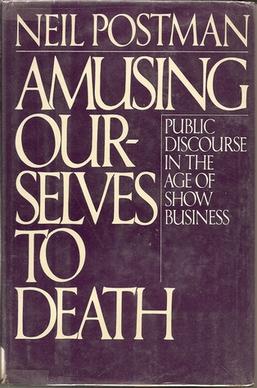
These are extracts from Amusing Ourselves to Death, Public discourse in the age of show business by Neal Postman, Methuen Publishing, London, 1985

Other Articles

Ineludible
¿La mejor canción de rock?


No Comment! Be the first one.