

By Ricardo Sanín-Restrepo
Borges, who in life claimed he wanted to disappear completely, has become the most ubiquitous of all writers. But what it has not been pointed out enough is that his literary omnipresence has a great deal to do not only with the cunning media presence he quietly orchestrated but more importantly with the type of short stories he conceived. This essay focuses on the latter and on his unrepeatable El Aleph
Language becomes communicable and thus common where there is no language that claims to ordain all languages, an alpha (Aleph) language, a constitution as a structure that organizes the movement of all languages in a definite and precise direction. The failure of language is its own potentiality.
No one has come close to capturing infinity (contingency) in opposition to the totality (necessity) of time as Jorge Luis Borges in his short story El Aleph (1945). While Borges is mourning the death of Beatriz Viterbo, his rival in love and fellow writer Daneri shows him El Aleph, ‘A point in space that contains all other points’. El Aleph is not on top of a proverbial mountain crowned as an absolute object of visibility but on a dusty cellar in Garay Street, Buenos Aires. To reach it, the spectator becomes a participant only by laying down on a shallow space in the floor to peek inside a small iridescent sphere. What did Borges see? ‘In that single gigantic instant, I saw millions of acts both delightful and awful; not one of them occupied the same point in space, without overlapping or transparency.’
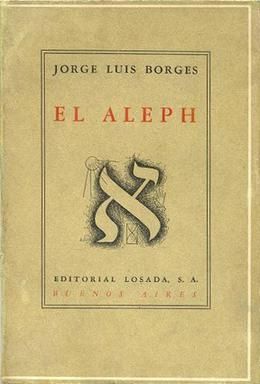
El Aleph is the first letter of the Hebrew alphabet; it is Cantor´s symbol for transfinite numbers. Just as the first device that writing must confront is the concept, in this case, the painful concept for Borges, is a universe that does not dwell in the loss of Beatriz Viterbo and that must be acknowledged as the same universe that holds this dirty little secret, shared by a dirty little man: Daneri.
The first thing Borges discovers is that El Aleph is the prohibition of sequence in time (a now). It is only space caught in a single instant which is therefore a frozen and sterile actuality, it is then the wrenching impossibility of action. Borges only saw ‘images’ of the universe, all images granted, but only images petrified in space. He saw the brush and the stroke but not the stroke of the brush becoming other. The immediate instant that revokes time must be an infinite space condensed as one instant, this is the uncanny contraption of time as totality. Only a space is needed to create all the spaces at the same time in the instant. There is no metaphor, no poetry, the Aleph is an orifice. One world, one eye beyond itself trapped in the world that by its own design cannot return the gaze back to the one who sees it. Thus, Borges confronts the primal terror as he sees all the mirrors and none of them reflect his image. In the Aleph, every moment is its own actuality, and potentiality as the ‘coming to be’ in time is barred by the ‘given’ perfection of what exists there in space.
The Aleph is an actuality of time where there is no difference. The subject, (be it there a subject) as the den of representation is dissolved and replaced by the orifice that holds all forms of representation from within. If there is only totality, then every representation is only possible by the totality and therefore nothing can represent it beyond its own form of representation. If time is a totality, language faced with the universe must duplicate it, it must destroy its own representation in order to mimic itself as totality. Insofar, the Aleph can only be understood in a founding or grounding (constituent) function. Communication of the instant becomes impossible for it requires the temporization of space.
Thus, a space that transmits no meaning is assumed in two different ways by two completely different temperaments. Daneri, the owner of the house, the mediocre writer, assumes it literally, as a foundation and as such an emanating of meaning which cannot be sensed and thus must be left to its own devices. Thus, the labour of the writer is to obey blindly the command of nothingness which becomes the libidinal link of the law of totality. The Aleph, as the totality of time, is infinite substance, as the first letter it contains meaning, but it does not contain any specific meaning, no relation. This lack of meaning is the original meaning, the revelation of an impossible command that when followed marks the path of the follower as coercion and obedience. Daneri only becomes a prolific writer after the house is demolished, after the round sphere of the Aleph becomes dust and all its geometry has imploded.
“The first thing Borges discovers is that El Aleph is the prohibition of sequence in time (a now). It is only space caught in a single instant which is therefore a frozen and sterile actuality, it is then the wrenching impossibility of action.”
The larval figure, the image devoid of content, a shadow that is projected in the space where the body grew, as Agamben explains, the root of hell is that images may have no end, that the likeness becomes an inextinguishable fire, death rotating on its own axis, now facing life, now facing death, transposing, and returning. In this hell of mere actuality all contraries come together, not in their opposition, but in their extension to form one intensity brewed in darkness where they become indistinct. Things which in the return are mere appearances, images, carcasses of what was left behind must speak from themselves to obtain substance, to become things in themselves in an ocean of voices that drown in a plane of indistinguishability (equality!). Borges refuses to believe that the aleph is ‘real’, for him it is just an optical device devoid of eventfulness. Writing about the Aleph, something timeless, is an impossibility as writing is the continuum of a trace in time. The irreversibility of time would make writing a dependent product that in order to fit within the law of the Aleph must turn itself into a shadow of obedience and turn the writer into a scrivener. Consequently, Borges ‘would prefer not to’ as Bertleby´s only option of freedom. If writing followed the Aleph literally it would always be lagging behind in the future, always expressing an image that has been extinguished by time and its passing, writing of something as a post-scriptum of what in the Aleph remains the same. The true power of the Aleph is then to turn subjective appetite for the divine into the divine itself through the mysticism of writing as absolute absence. Since writing puts time into motion, it launches it back into space.
“The Aleph is an actuality of time where there is no difference.”
Spinoza’s substance as the innumerable attributes of God, of which we can only account for time and space, are reduced to an image of space, an iron-clad architecture of volume and mass devoured by the transcendence of time as totality. Only in the abandonment of language to language can El Aleph show any meaning whatsoever, that is, only rejecting and then inventing El Aleph in writing, does El Aleph come to life. Only by representing what represents the impossibility of representation may the writer rid writing from its own impossibility. Thus, time as an invention cannot occupy any transcendent space whatsoever, it is always contingent on the appearance of the incomplete other that tears time at its seams through the name ‘now’. Borges comes to the limit as a writer; since he can only express successively what he saw as simultaneous, time loses every reference to totality, it becomes plastic in the necessary act of extension of its own denying limits, that are only limits by the fact of its inexistence as time. Time in writing becomes the interstice of being, the incurable wound of being other, the opening of absolute difference. Seeing the world from El Aleph from every angle and the earth containing El Aleph through El Aleph and through it the earth as well, is only possible by destroying time as an absolute, that is by destroying El Aleph.

Time as totality turns out to be the failure of language, the collapse of communication. For Borges writing is the only opening to resist the totality of image, the oppression of actuality as a horrifyingly mute monolithic form of forms. Language becomes communicable and thus common, where there is no language that claims to ordain all languages, an alpha (Aleph) language, a constitution as structure that organizes the movement of all language in a definite and precise direction. The failure of language is its own potentiality. Language becomes communicable when it ceases to obey time as totality and thus every space reconstitutes itself from within time.
Language becomes pliable when it rejects obedience, this is the condition of immanence of power, and as such, it becomes the ontological condition of politics. Its fundament, is that there is no subject prior to politics, and that politics, as antagonism, is where the subject comes to the full beingness of her becoming. In this very precise sense, democracy stands as the only viable space of politics, since any form of power that bequests any form of qualifications or conditions in order to exercise politics are but forms of domination through violence, and thus, the outright denial of politics. Henceforth, time is always the distance between two worlds, the real and the imaginary.
Change occurs in time but time itself cannot be harnessed, it seems as a thing in itself, an autonomous order that dictates the order of change. Time in its movement is inapprehensible, it always fluctuates between a not yet this, and a no longer that, so to try to capture it, is to capture what it is not, since it has not yet been, or it already was. The way to attest to the dictatorship of time is that things do change and the things that change cannot be brought back to a previous state. The latter implies that time has two conditions, it is successive and irreversible. Nevertheless, as the knowing subject is imbued within the same time, like water to the river, both as depth and surface, she cannot jump out of it to see its flow from a distance.
In the Physics, Aristotle engages the eccentricity of time: ‘To start, then: the following considerations would make one suspect that it either does not exist at all or barely, and in an obscure way.’ And here we can enounce the most problematic paradox of time, time is made up of things that do not exist. The only particle which can hold this necessary nothingness together is a now (nun) a non-temporal particle that affords time existence, so change can hold its substance. The nun is a construction of a name, a graph, as a numbering name that once said is devoured back into the current of time. Nun (Punktualitat in Hegel´s jargon) is a name that carries an elusive existence, for once it has been pronounced, from beginning to end, like the afterglow of a flame in a bonfire, it ceases to be temporal, it becomes a dead liturgy, a mere representation of memory. The ‘now’ is the necessary non-simultaneity of time, that is, where past and future can be held at a distance through a present that will cease to be. Time is divisible into parts, but no now is in the present. Borges, the master of paradox, unveils the bewilderment at hand: Sextus Empiricus denies the existence of the past, that which already was, and the future, that which is not yet, and argues that the present is either divisible or indivisible. It is not indivisible, for in such a case it would have no beginning to link it to the past nor end to link it to the future, nor even a middle, since what has no beginning or end can have no middle; neither is it divisible, for in such a case it would consist of a part that was and another that is not. Ergo, it does not exist, but since the past and the future do not exist either, time does not exist.
“Change occurs in time but time itself cannot be harnessed, it seems as a thing in itself, an autonomous order that dictates the order of change.”
As Derrida explains, nun only becomes temporal in ceasing to be, in passing onto nothingness, it is ‘The non-modifiable nucleus of temporal modification’. And here lies the pit of the paradox, for if the nun is to participate in being it must not be affected by time, for time is nothingness, so it will have to be present to itself. If substance is to be predicated of anything it must abandon the nothingness of time and its punishing demolition of instants. The now becomes other than itself, so its essence is a non-being where everything exists.
The nun brings differentiation and qualification to time, it is the negation of non-being of time, it adds itself as an artifice to define time. Time must be marked in order to exist. The mark of time negates the pure abstractness of space, it localizes space against itself, it ‘suppresses and replaces the place’. In the words of Martin Hägglund:
“The classical distinction between space and time is the distinction between simultaneity and succession. The spatial can remain the same, since the simultaneity of space allows one point to coexist with another. In contrast, the temporal can never remain the same, since the succession of time entails that every moment ceases to be as soon as it comes to be and thus negates itself. Time is nothing but negation, so in order to be anything it has to be spatialized. There is no ‘flow’ of time that is independent of specialization, since time has to be spatialized in order to flow in the first place.”
Picture your finger drawing a line in the air (space) in front of you. It marks space as it necessarily takes it and occupies it, but it is also the positivity of time, the drawing of the line is accomplished only through the opening of time as an instant. Hence, the creation of space is also the rendering of the possibility of time. Space can only be thought of as time in the instant, as the paradoxical negation of time. Space can only come into being when it is negated by time as time can only come into being negated by space. Poetry, always nests the soul with truth, Clarice Lispector captures the evanescence of the now ‘Of dying, yes, I knew, for dying was the future and it is imaginable, and to imagine I always have time. But the instant, this instant, – actuality – this is not imaginable, between actuality and I there is no interval: it is now, in me ’
A now must be named, it must be marked and bracketed: ‘now’ the sun is up, now the song One Entrance, Many Exits by Mal Waldron is playing on the radio, now the pyramids are standing. ‘This leads to the definition of time as the number of movement following the before and the after’, so time must be driven to the concept of the numbered number as it denies its definition as substance. The number is simply a unit to name the before and after, a distinctive enumeration of the space of movement, such that in 10 pencils, 10 is not a property of being a pencil. This is why, for Borges ‘the chronological fixing of an event, of an event in the universe, is alien and external to it.’
‘Now’ is the unity of measure, the numbered number of time. To draw a first conclusion, time can only be continuous according to the mark. Hence, time in its totality is not present, it does not participate in ousia (substance). Consequently, the now cannot denote the totality of being. Aristotle rejects the possibility of considering the now as the mark of time as a gramme, that is, as a composition of parts each one serving as a limitrophe point. The ‘now’ stands in a kind of highland from where it pulls the strings of the future and the past, this will be Hegel´s opening to substitute this now with an omniscient Spirit that drives time at its superb rhythm provided by a ‘reason’ which is time itself.
Derrida wants to reveal that every so-called ‘present’, or ‘now’ point, is always already compromised by a trace, or a residue of a previous experience. The trace precludes us from ever being in a self-contained ‘now’ moment that is its own impervious, autonomous and solid absolute. He thus argues that the passage of the now necessarily requires a split within presence, such that presence is never purely present but is always already ‘contaminated’ from within by absence. As Robert Brandom reminds us ‘the given is an already conceptually structured world’. If time requires a mark in order to exist, it cannot therefore anticipate beingness, even if, as Hegel strides to prove it, this beingness is time. Time as beingness would foreclose the possibility of the ‘other’ of difference, for it would suppose an internal identity of every being with itself in time. As Hägglund clarifies, ‘every finite other is absolutely other, not because it is absolutely in itself but, on the contrary, because it can never overcome the alterity of time and never be in itself. This becoming absolute other is difference, which can only be understood as pure contingency when the necessity of the absoluteness of time is eradicated by a being ‘becoming other’ against time PHUSIS. Consequently, time is not a part and does not belong to beingness (ousia) in any form at all, for if it did, time would be a transcendent model that subjugates the ‘becoming other’ through difference.
“This leads to the definition of time as the number of movement following the before and the after’, so time must be driven to the concept of the numbered number as it denies its definition as substance.”
The cornerstone of this substantializing picture of the history of metaphysical thought is supposing being as already in time, already an anticipating silhouette, a mold of flesh and bone levitating in a space external to space. A mystifying form of transcendence that comes to be what it already has to be by the force of the total now. Any attempt to put an entity before meaning opens the necessity of the entity to identify itself with a meaning it denies. In this precise sense, Hegel diminishes difference through a totalization of time, where the dialectical negation of the given must be presupposed in the totality that is time in such a way that denying identity is simply affirming the totalized identity that is already crouching in a hidden form of time. It is a ‘mystifying’ form of transcendence since ‘men’ (in Hegel´s words) can only become what they already are in the concept held at the end of time. To maintain the façade of immanence Hegel has to turn time into the primordial substance, but as we are demonstrating time as substance is not only an impossibility but the outright denial of difference through the presupposition that difference is already anticipated by a precise model of time.
This is an extract from the article The People vs. Hegel: The Mystifying Transcendence of Time and the Immanence of Radical Democracy by Ricardo Sanín-Restrepo published in Decrypting Power, Rowman and Littlefield Int. London. 2018.
Ricardo Sanín Restrepo is lecturer in various universities across The Americas. He is the author of Being and Contingency (Rowman and Littlefield 2020) translated and published in Spanish as Ser y Contingencia, Tirant lo Blanch. 2023. He has also penned numerous academic and cultural articles for many magazines including Perro Negro. Those interested can purchase his book El cuerno de Gabriel here

Other Articles
El sínodo
The Slut and the Idiot


No Comment! Be the first one.