

By Hernán B. Aliaga
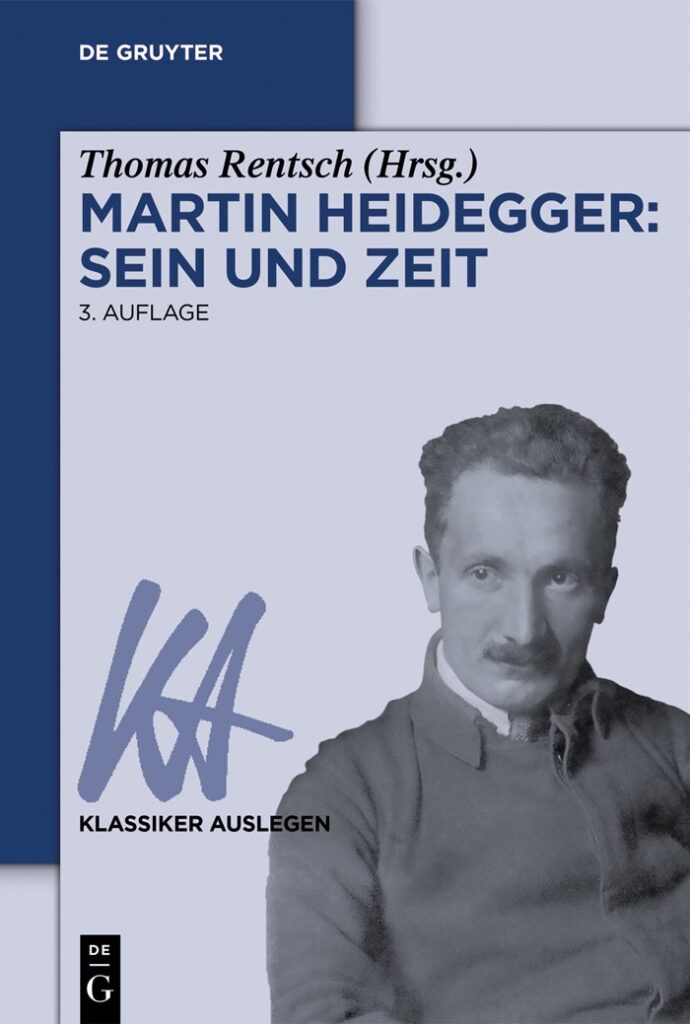
Published ninety-nine years ago, Being and Time (Sein und Zeit) became an immediate and colossal success. It marked the beginning of existencialism with its focus on “the question of being” and our own finitude. One of those questions is the non autonomous life because it is lived under norms and expectations we have not chosen. In his book, Heidegger invites us to embrace instead a more authentic existence (Eigentlichkeit). Our philosopher at large mentions how to do it
What if I told you that remembering that you’re going to die might be the key to starting to live for real?
This is what Heidegger puts forward in this book, which is a thousand and one books (Sein und Zeit): that we live, in general, in an inauthentic mode of existence, absorbed by what he calls the One (das Man), a way of life in which we think, speak, comment, behave as “it is done,” as “it must”, like “everyone does.” Not because someone imposes it, but because it is the very structure of everyday life.
To live in the One is not to be autonomous, it is to live in heteronomy: under norms, expectations and perceptions we have not chosen, but which we execute and repeat as our own.
It is the conformity, the automatism, the anonymity of those who no longer ask about the meaning of their life because they live according to the criteria of success, happiness or truth of a world that has already been interpreted. We thus dissolve ourselves in a world that is already done, and in which we simply insert ourselves docilely for comfort, habit, fear of going out of the norm, desire to fit in, etc.
But then – sometimes without warning – something breaks in that artificial calm: the experience that we are going to die. What the ancients called memento mori. This is not a moral reminder, as for the Stoics or the Religionists, but an ontological call: an experience that de-automates life and returns us to the very core of existence.
Whoever has experienced the near death of a loved one, or has felt in a real and concrete way the possibility of his own death, possibly knows this feeling. A painful shadow that is both lucidity and vertigo. The world loses its solid appearance, and many things that once seemed important reveal their banality. Others gain weight.
The memento mori in Heidegger is not an ethical warning, but an existential alarm. It reminds us that no one can die in our own death and therefore no one can live for us. That our being is untransferable. And that only from this radical consciousness of finitude can we begin to live authentically.
Of course, we can also escape. Turn off the alarm clock. Turn on the other side and stay asleep. Return to the banal comfort of the One. But whoever reacts to the call and takes charge of his finite self, of his being for death, begins to live in a different way: not as an anonymous piece merely functional, but as someone who appropriates his time and his world.
To live authentically, for Heidegger, is not to live better, or more intensely, or happier, but to live with greater truth. It is to inhabit a life chosen, not simply inherited. A life that has appropriated itself. Heidegger does not propose individualism, nor does he seek to oppose the “I” to the collective. Authentic life is not to replace the ordinary, but to inhabit it in an alert, finite, and responsible way by answering the one question that cannot be delegated to another:
What am I going to do with my being before I stop being?
Hernán B. Aliaga is a writer and a social philosopher. He is a former lecturer at Pontificia Universidad Católica, Peru. He has been educated between Lima and Berlin where he now lives and is working on his doctoral thesis on social theory. He is an active commentator on social media. This is the first of a series of articles on social philosophy for Perro Negro in English. Most have already posted in Spanish in his Instagram page. You can also follow him on https://hernanbaliaga.substack.com/ and TikTok

Other Articles

“El último que salga que apague la luz”
A Sufi Gathering in Syria



No Comment! Be the first one.