

Por Gustavo García
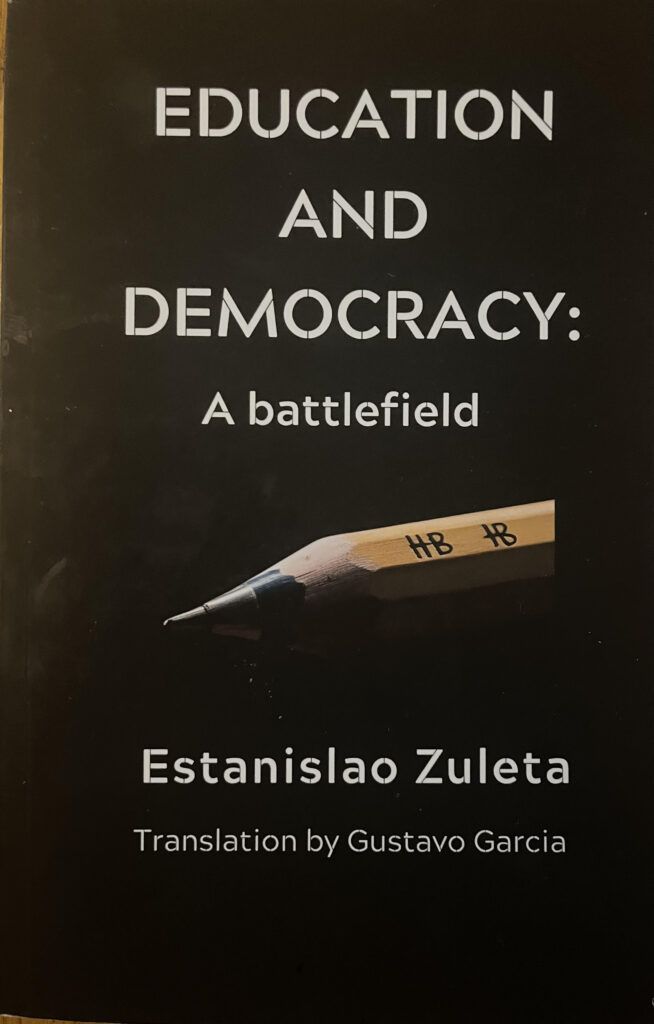
We mark the publication, for the first time ever in English, of the work of Colombian philosopher Estanislao Zuleta. The translation is the work of one our closest collaborators. Here we reproduce his foreword of a book whose topic is more pertinent than ever in Western liberal democracies, particularly The United States of Donald Trump
The ubiquity of the English language is both a blessing and a curse for native English speakers: on the one hand, the world’s cultural, academic and commercial spaces are easily accessible to us all. However, native English speakers are far less likely to be bilingual: as a consequence, we are denied the multiple advantages which research shows us are associated with bilingualism, including cognitive, health, economic, social and cultural benefits.
Despite these findings, the anglosphere not only suffers from a distinct lack of bilingualism – the window par excellence into another culture – but the highly anglocentric world of publishing means that we are fed a relatively impoverished diet of knowledge and culture. For example, English currently accounts for 80% of all journals published within the scientific community and, according to Arenas-Castro et al (2024), although knowledge is produced in many languages, the practice of publishing predominantly in English “creates a language barrier to generate and transfer scientific knowledge between communities with diverse linguistic backgrounds, hindering the ability of scholars and communities to address global challenges and achieve diversity and equity.” Translated fiction in the UK fares even worse given that it is limited to just 3 to 5% of all book sales. Of those titles that are translated, the majority are European, with French being the most commonly translated language and more recent translations increasingly coming from Norwegian and Swedish. The consequence is an almost entirely eurocentric (or North American) perspective, leading to a blind spot when understanding the original thinking which emerges from the Global South. If English speakers value the thinking of others, we deserve to be offered far more work in translation; if we don’t, we are destined to a future of insular navel-gazing. This is a problem because homogeneity in any sphere can be harmful: we know, for example, that genetic diversity (heterozygosity) provides significant advantages over time to populations, as well as improved fitness and resilience to individuals. Similarly, cultural diversity can improve societies’ resilience by fostering creativity, problem-solving and adaptability: one optimal way of achieving this is undoubtedly by insisting on a greater commitment to reading in translation. It is within this context that Education and Democracy has been chosen for translation and publication. But what do we know of its author?
Estanislao Zuleta (1935-1990) was a towering figure in possession of a vast erudition and one of the most influential intellectuals of the twentieth century in his native Colombia. Unlike other thinkers, Zuleta refused resolutely to be pigeon-holed into any single area of specialization: his corpus of published work spans the disciplines taking in fields as diverse as philosophy, psychology, sociology, economics, education, law, literature, politics, psychoanalysis, art, poetry and much more. A precocious child and a steadfast autodidact, Zuleta chose to leave school at the tender age of 16 on the grounds that it didn’t leave him enough time to develop his own thinking. It is unsurprising, therefore, that in Education and Democracy, the reader will find a devastating criticism of the traditional form of schooling which seeks to transmit facts – or the outcomes of other people’s thinking – without ever teaching, encouraging or even allowing for critical thinking.
Zuleta is known primarily as a philosopher, lecturer, researcher, consultant, public speaker and essayist. In addition to his academic work, Zuleta also worked as an adviser, not only for the Ministry for Human Rights at the United Nations, but also for presidents Belisario Betancourt and Virgilio Barco, advising in relation to the armed conflict and the establishment of peace talks. As a teacher, he was very well-respected, highly regarded and fondly remembered as being incredibly charismatic. His only academic qualification, an Honorary Doctorate in Psychology from the University of Valle, Universidad del Valle, was awarded to him so that he could be employed as a lecturer and he went on to teach at a number of prestigious universities (National University of Colombia, University of Antioquia, University of Valle and Free University of Colombia). Such was Zuleta’s command and depth of a range of interdisciplinary subject-matter that his (often improvised) lectures are known for their capacity to captivate and inspire generation after generation of students.
Enigmatic yet charming, Zuleta eschewed writing wherever possible, preferring instead conversation and dialectics with the philosopher Fernando Gonzalez, the poet Leon de Greiff, friends, colleagues and students or lecturing to large audiences: always in-depth and always with precision and clarity. Much of his surviving work is the result of conferences and lectures which were recorded and subsequently transcribed. To those who knew him, he was a modern-day Socrates.
While Zuleta wasn’t exclusively inspired by German thinkers, the depth and originality of his work stems from the influence of figures such as Thomas Mann, Nietzsche, Heidegger, Marx, Freud and Kant in addition to other global figures like Plato, Spinoza, Tolstoy, Cervantes and Shakespeare. His thinking is the result of an incredibly rich tapestry of a diverse set of sources, philosophical schools and academic disciplines which all enabled him to develop a unique and entirely original critique of a range of issues. Zuleta needs no rescuing from obscurity in his native Colombia where he is widely celebrated; I hope that the English reader enjoys discovering one of Latin America’s most original twentieth century thinkers while delving into his thoughts on two interrelated topics of such profound importance: Education and Democracy.
(London, May 2025, Gustavo García – translator)
Education and Democracy: A battlefield by Estanisalo Zuleta, translated from Spanish by Gustavo García is published by Editorial Perro Negro. To purchase this book click here. Gustavo García is an essay writer, a translator and also a languages teacher and head of department. He has a degree in Classical Civilisations from Leeds University with an MA in Education. He is a father and, like Eduardo Galeano, a frustrated footballer. He lives in South London

Other Articles

Rodrigo Rodríguez: música y soplo zen
Fraude de fusión en frío


No Comment! Be the first one.