

By Dr Marcela Ondekova
Róbert Fico is one more on a list of corrupt, populist and anti-democratic leaders that in spite of being part of the European Union have lined themselves with Putin and Trump’s agenda of a global hegemony of extreme-right politics. From Bratislava we receive this brief genealogy of what has happened in Slovakia since the promising days of the Velvet Revolution and the reasons for being cautiously optimistic
I was 17 when the Velvet Revolution began in 1989 in what was then Czechoslovakia. I grew up in modest conditions in the countryside, in a family that did not support the Communists and did not benefit from the regime like those who had collaborated with it. My prospects would not have been great if the Communists had stayed in power. Yet my elderly father now supports Róbert Fico and closes his eyes when Fico celebrates Russia and defends its “right to protect itself” from NATO. What happened?
The jubilance of the fall of the despised regime did not last long. It was soon replaced by the bewilderment of the 1990s. In our small town, the wild privatization of public property was exactly that—wild. I didn’t fully understand it at the time, but today’s power structures are rooted in those years. The Communist regime didn’t just disappear—it morphed into a new elite. Those with access suddenly got ownership of buildings, land, factories. Former members of the Communist Party joined new political groups.
For people like us, though, new opportunities did open. I was among the first to leave our village for Ireland to learn English as an au pair. I later moved to the capital, Bratislava, to study at a university of my choice, and then went back to Ireland for a Master’s programme and PhD, which I paid for myself. Others in the village tried small businesses. Some did well, many burned themselves—money was good, but entrepreneurial experience was not. There is still an abandoned building in our village because the owner ran away abroad rather than pay his debts. I remember his wife boasting about earning their first million crowns—something the rest of us couldn’t even imagine.
At that time, I still didn’t pay much attention to politics—I was busy with my own life as a student—but it was impossible to ignore the populist Vladimír Mečiar’s rule. Through friends studying journalism, I started going to protests, wearing T-shirts saying “Mečiar is lying.” When he was finally defeated in 1998, he cried on national television. But there was no sympathy for him—he was a power-hungry bully, now reduced to a pathetic figure. The Mikuláš Dzurinda government felt like we finally got a democratic leader—a leader respected by the West. He appeared on Larry King and was quite charming. Under him, what once seemed impossible became real—we joined NATO and the EU in 2004.
The day we entered the European Union stays with me. As a young, ambitious woman, I wanted to discover a world that had been closed to us under the Communists. Before EU membership, however, we could travel but were treated with suspicion. In Vienna, I was watched in shops as if I might steal something. At airports in London and Dublin, immigration officers went through my papers and questioned me in a way that felt humiliating.
Part of it was understandable: increased mobility and economic upheaval after 1989 did contribute to the growth of cross-border organised crime, including trafficking and smuggling networks. However, perceptions of Central and Eastern Europeans were often amplified by stereotypes in media narratives—much like those we see today in portrayals of migrants from the Middle East and other regions.
“The Communist regime didn’t just disappear—it morphed into a new elite. Those with access suddenly got ownership of buildings, land, factories. Former members of the Communist Party joined new political groups.”
It wasn’t just about travel, study, or work. Entering the EU was also about identity. I felt we finally belonged to Europe—to modernity, to progress. It felt like Slovakia—and I—could only move forward. But progress is not linear.
Despite early successes, weak institutions, inexperienced political parties, and shadow business interests became apparent. Organized crime, cars set on fire, and corruption cases were daily news. While there was some improvement in living standards, it was not even across regions, and some regions experienced high unemployment. In 2005, the eastern region, where I come from, had close to 18% unemployment compared to less than 3% in Bratislava. These inequalities and frustrations created the conditions for Fico.
In his early years, he appealed to many. He wasn’t as aggressive as Mečiar, more calculated. Some saw him as a clever politician. In his youth, he was a member of the Communist Party and after 1989 joined the Party of the Democratic Left before creating his own with a marketable name, Smer (Direction). Fico spoke to people like my father—men who didn’t benefit from privatization and didn’t want to or couldn’t take risks as entrepreneurs. Many of them—those who in their younger years had rejected the Communist regime—started to miss the security it had offered. Fico understood that. He tapped into that frustration.
It was not just men, of course. Many women felt lost in the new system. For those with lower qualifications, jobs were insecure, while social protections weakened. The gap between those who could move, study, adapt—and those who couldn’t—kept growing. Many women left to work as carers in Western Europe, doing jobs others didn’t want to do. My region, Prešovský kraj, had the highest rate of migration abroad between 2005 and 2009, which represented close to 30% of all foreign migration in Slovakia in that period.
As the divide between the capital and the poorer regions grew wider, so did frustration. New generations found themselves in similar positions as their parents—unable to succeed in an unequal system. It was not only an economic divide, though, but ideological. The narrative of abandonment and a careless Bratislava elite grew stronger. Instead of looking for ways out, these regions started to look inward—the nationalism and xenophobia were buttressed by the rhetoric of “traditional Christian values” of family—i.e. stances against feminists, LGBTQI people, artists… anybody and anything that symbolized progress. Moreover, the Slovak National Party fueled strong anti-Hungarian sentiment, alienating the country’s largest ethnic minority.
There was a brief relief from Fico’s rule, when the only female Prime Minister so far, Iveta Radičová, tried to lead the country between 2010 and 2012. I say tried. Her coalition partners with large egos didn’t help her much, and the fall of this progressive government brought Fico back, where he stayed until 2018, when he was forced out following the murder of an investigative journalist, Ján Kuciak and his fiancée, Martina Kušnírová. The relief was short-lived. The mismanagement and chaotic government during the COVID pandemic persuaded many people that the opposition cannot govern.
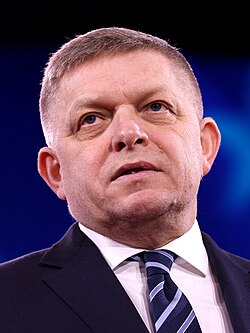
Now, this is Fico’s fourth government. If it were not tragic, one could laugh every time he blames the opposition for the state of the country given that he is the longest-serving prime minister since independence in 1993.
The next couple of years—2026 and 2027—will therefore be critical. There are reasons for cautious optimism when we look at Poland or Hungary. But what we are facing is not the Fico of the past.
This is something else—a more entrenched autocrat who wants to cling to power and avoid criminal investigation.
Before, he sometimes crossed the line—but you could still have a relatively decent discussion with him. There were still some rules. Now, the only rule is to stay in power. Like Victor Orbán, Fico and his circle have worked tirelessly to weaken democratic institutions. Not always successfully—but enough to matter.
As under Orbán, public TV and radio are becoming tools of Fico’s propaganda. Civil society organisations are investigated and portrayed as enemies of the state, while the judiciary has also been weakened by constant attacks, even against the formerly aligned General Prosecutor. It is now standard that journalists’ questions are treated not only with hostility but also publicly humiliated, especially women.
Corruption feels more open now, almost as if coalition politicians are not even trying to hide it anymore. Parliament often feels paralysed—either inactive or just pushing through laws that benefit those in the coalition parties or, more precisely, the inner circle of Fico. Nepotism is everywhere, including the secret police chief, who is the son of a close Fico collaborator (a man facing a criminal investigation), appointed without any actual previous experience or obvious aptitude for the role.
Incompetence is what our youth can see in Parliament. How should this motivate them to study? Take some of the men from coalition parties. And yes, men, as women hold just 22% of the seats in Parliament, and opposition female MPs are almost three times as many as those from the coalition parties. Many are barely able to put a sentence together—yet quick to decide on increasing their own salaries while the economy keeps sliding.
“It was not only an economic divide, though, but ideological. The narrative of abandonment and a careless Bratislava elite grew stronger. Instead of looking for ways out, these regions started to look inward—the nationalism and xenophobia were buttressed by the rhetoric of “traditional Christian values” of family.”
At the same time, politics has become rougher, more aggressive. Misogynistic slurs are used to attack female opposition politicians. Xenophobic, extremist, and anti-LGBTQI rhetoric has become normalised. In my home region, a neo-Nazi wants to run for governor this year. These politicians have no real solutions for rising costs of living or for companies relocating from Slovakia because of increased costs imposed by Fico’s government. Instead of supporting struggling small businesses, draconian measures are being adopted that lead to their closure. In 2025, more than 66,000 self-employment licences were cancelled—the highest number in a year since the country’s independence.
So while, privately, my father has been proud of my career as an international advocate of women’s rights and democratic governance, publicly he has been supporting the person who embodies the exact opposite.
Almost four decades after the Velvet Revolution—I am worried about where Slovakia is heading.
Worried about apathy—people who know things are bad but don’t want to deal with politics and won’t vote in the regional elections this October or the national elections next year. Worried about young people who support change but won’t show up. We’ve had many anti-government protests in recent months—but young people have not shown up in the numbers we’ve seen elsewhere. I’m also worried that the opposition doesn’t fully understand the frustration of those who feel excluded.
Not all are brainwashed “deplorables”, and we need to find ways to mobilise people. I know there are many women from the countryside who do not like the aggressive style of coalition politicians. There are also many progressive people in the regions who overwhelmingly vote for Fico. They need to be supported in their work. I am also worried that the EU doesn’t pay enough attention. As someone recently said to me—who cares about elections in a country of five million? But this is not about numbers. It’s about what Fico represents—and how his politics encourages others like him. His fall would matter far beyond Slovakia.
After decades of building democracy, to be at this point—in the middle of Fico’s fourth government, with a stagnant economy and being called a pariah country in the EU—it’s easy to feel frustrated, even disillusioned. But there are still reasons not to give up.
There are opposition leaders who want to fight corruption and have competence. There are also strong women in politics I am proud to support. At the regional level, democracy often works better than at the national level. Even in my village, people vote for local representatives who actually do something to improve life there. And, ironically or not, my father is proud to show me these improvements on every visit.
Civil society is still active, still pushing back against the attacks on democracy. More public personalities speak up against the authoritarianism that has crept back and reminds many of us of the Communist regime’s tactics of silencing the opposition.
There is hope—but hope is not enough. Hungarian voters have shown their support for the opposition—they surely did not agree on every little detail. There is criticism of some of Péter Magyar’s positions. But there was a uniting element—to get rid of the corrupt Orbán regime and give Hungary a chance to prosper. This is what we need too—put aside differences and show up—this October and also next year—to get rid of the regime that is taking us away from Europe. I was not standing in the rain in 1989 for this. I was there because I believed we could be a prosperous, progressive, and forward-looking European country—a proud member of the European Union.
So please, keep your interest and your support. We will need it.
Dr Marcela Ondekova is a Slovak-born expert in democratic governance and women’s rights. She has spent over 20 years working internationally in Asia, the Middle East, and Africa, including in conflict zones. Her current work focuses on building civic initiatives and partnerships with municipalities in Slovakia, as well as advancing women’s political participation. She is an alumni of the London School of Economics and Cork University Business School.
Image: Róbert Fico in 2925, Wikimedia

Other Articles

Diarios de Plomo XVI
“El último que salga que apague la luz”

No Comment! Be the first one.